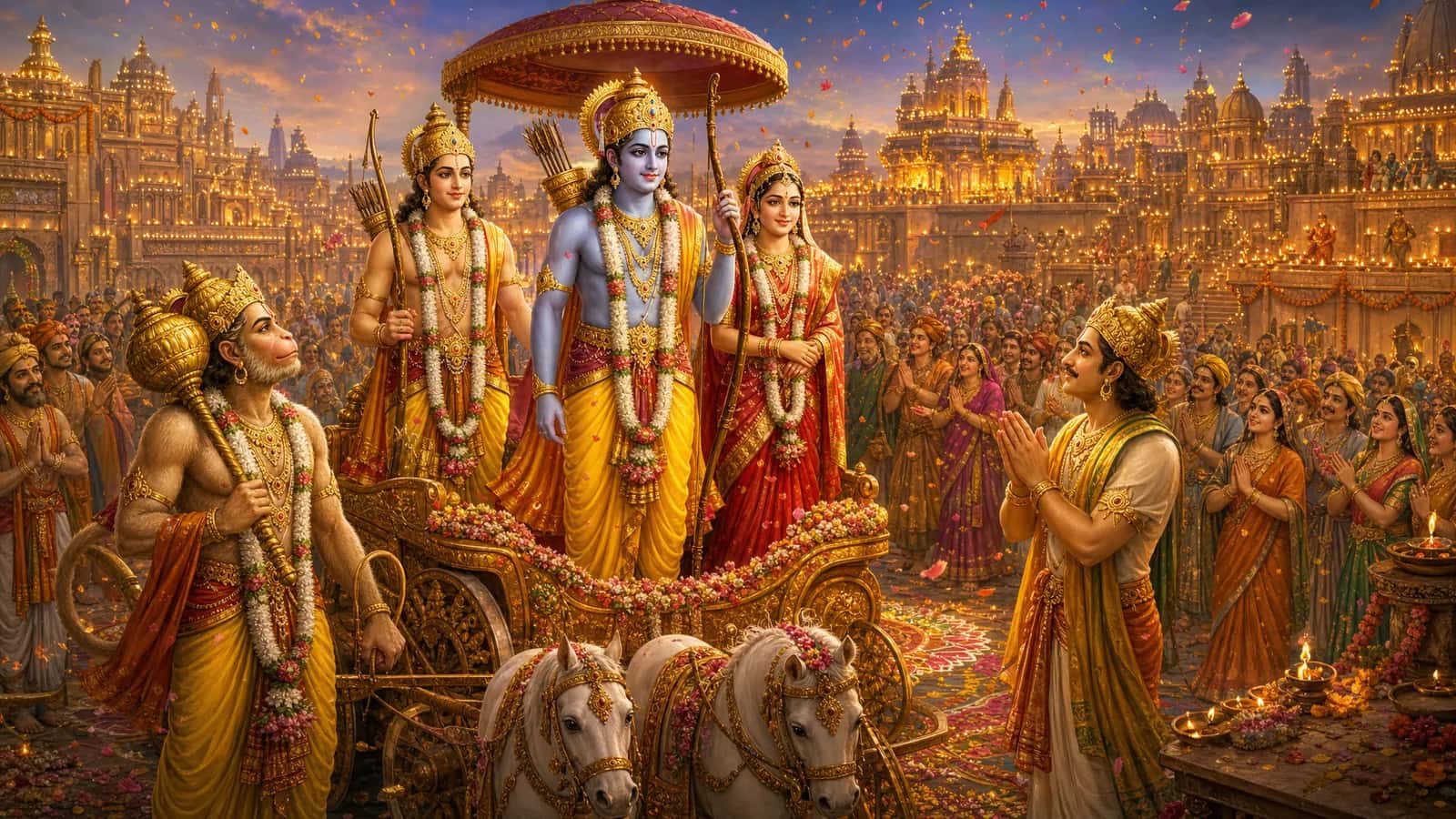
Uttar Kand brings us into Ram Rajya, then turns towards the dialogues of Kakbhushundi and Garuda. After the coronation, the story gives space to the teaching of bhakti. The events we have followed now lead us to consider how devotion is to take root in our own lives. Listening remains an active part of this learning, as the dialogues carry the teaching forward.
The kand praises the remedy available in the Kali Yuga: the Name. Here, attention rests upon the practice of remembering Shri Ram. The account of His deeds leads naturally to devotion to Him, and the teaching directs us towards a practice we can continue each day.
Uttar Kand contains 130 dohas. Its teaching is to make devotion a daily practice through remembrance of Shri Ram’s Name. To keep reading on the phone, continue with the Ramayan app, giving a little time each day to the scripture.
In this kand
- InvocationInvocations
- InvocationBharata’s desolation; meeting of Bharata and Hanumān; rejoicing in Ayodhyā
- Doha 2bŚrī Rāma’s Reception; meeting with Bharata; universal rejoicing on meeting Śrī Rāma
- Doha 11cŚrī Rāma’s Coronation; Vedas’ alleluia; Lord Śiva’s alleluia
- Doha 15Śrī Rāma bestows parting presents on the monkeys and the Niṣāda chief
- Doha 19cAccount of Śrī Rāma’s Reign
- Doha 25Birth of sons to the four brothers; Ayodhyā’s loveliness; arrival of the sage Sanaka and his three brothers and their dialogue with Śrī Rāma
- Doha 34Hanumān’s introduction of Bharata’s question and Śrī Rāma’s discourse on the subject
- Doha 42Śrī Rāma’s exhortation to His subjects (Śrī Rāma-Gītā); the citizens’ acknowledgement
- Doha 47Dialogue between Śrī Rāma and the sage Vasiṣṭha; Śrī Rāma’s excursion to a mango grove in the company of His brothers
- Doha 49Nārada’s visit and return to Brahmā’s abode after hymning the Lord’s praises
- Doha 51Dialogue between Lord Śiva and Goddess Pārvatī; Garuḍa’s delusion; Garuḍa listens to Śrī Rāma’s story and to an account of His glory from Kākabhuśuṇḍi
- Doha 95bKākabhuśuṇḍi narrates the story of his previous lives and tells Garuḍa the glory of the Kali age
- Doha 106bInsult offered by him to his preceptor in a previous birth and the curse pronounced on him by Lord Śiva
- Doha 106bA hymn of eight verses addressed to Lord Śiva
- Doha 108dGuru’s appeal to Lord Śiva for forgiving the wrong; mollification of the curse; continuation of Kākabhuśuṇḍi’s narrative
- Doha 110dKākabhuśuṇḍi approaches the sage Lomaśa, who first pronounces a curse on him but later on showers his grace and bestows a boon on him
- Doha 115bDelineation of Jñāna and Devotion; a description of the Lamp of wisdom and the surpassing glory of Devotion
- Doha 120bSeven questions of Garuḍa and Kākabhuśuṇḍi’s replies to them
- Doha 121bGlory of adoration
- Doha 122bGreatness of the Rāmāyaṇa; Tulasīdāsa’s prayer and reward of reciting this poem
Contents
- ॐ
- 1b
- 2b
- 3c
- 4b
- 5
- 6b
- 7
- 8b
- 9b
- 10b
- 11c
- 12c
- 13b
- 14b
- 15
- 16
- 17b
- 18b
- 19c
- 20
- 21
- 22
- 23
- 24
- 25
- 26
- 27
- 28
- 29
- 30
- 31
- 32
- 33
- 34
- 35
- 36
- 37
- 38
- 39
- 40
- 41
- 42
- 43
- 44
- 45
- 46
- 47
- 48
- 49
- 50
- 51
- 52b
- 53
- 54
- 55
- 56
- 57
- 58
- 59
- 60
- 61
- 62b
- 63b
- 64
- 65
- 66b
- 67b
- 68b
- 69b
- 70b
- 71b
- 72b
- 73b
- 74b
- 75b
- 76
- 77b
- 78b
- 79b
- 80b
- 81b
- 82b
- 83b
- 84b
- 85b
- 86
- 87b
- 88b
- 89b
- 90b
- 91b
- 92b
- 93b
- 94b
- 95b
- 96b
- 97b
- 98b
- 99b
- 100b
- 101b
- 102b
- 103b
- 104b
- 105b
- 106b
- 107b
- 108d
- 109d
- 110d
- 111b
- 112b
- 113b
- 114b
- 115b
- 116b
- 117d
- 118b
- 119b
- 120b
- 121b
- 122b
- 123b
- 124b
- 125b
- 126
- 127
- 128
- 129
- 130b
The seven kands
From the Gita Press, Gorakhpur edition. Buy the book