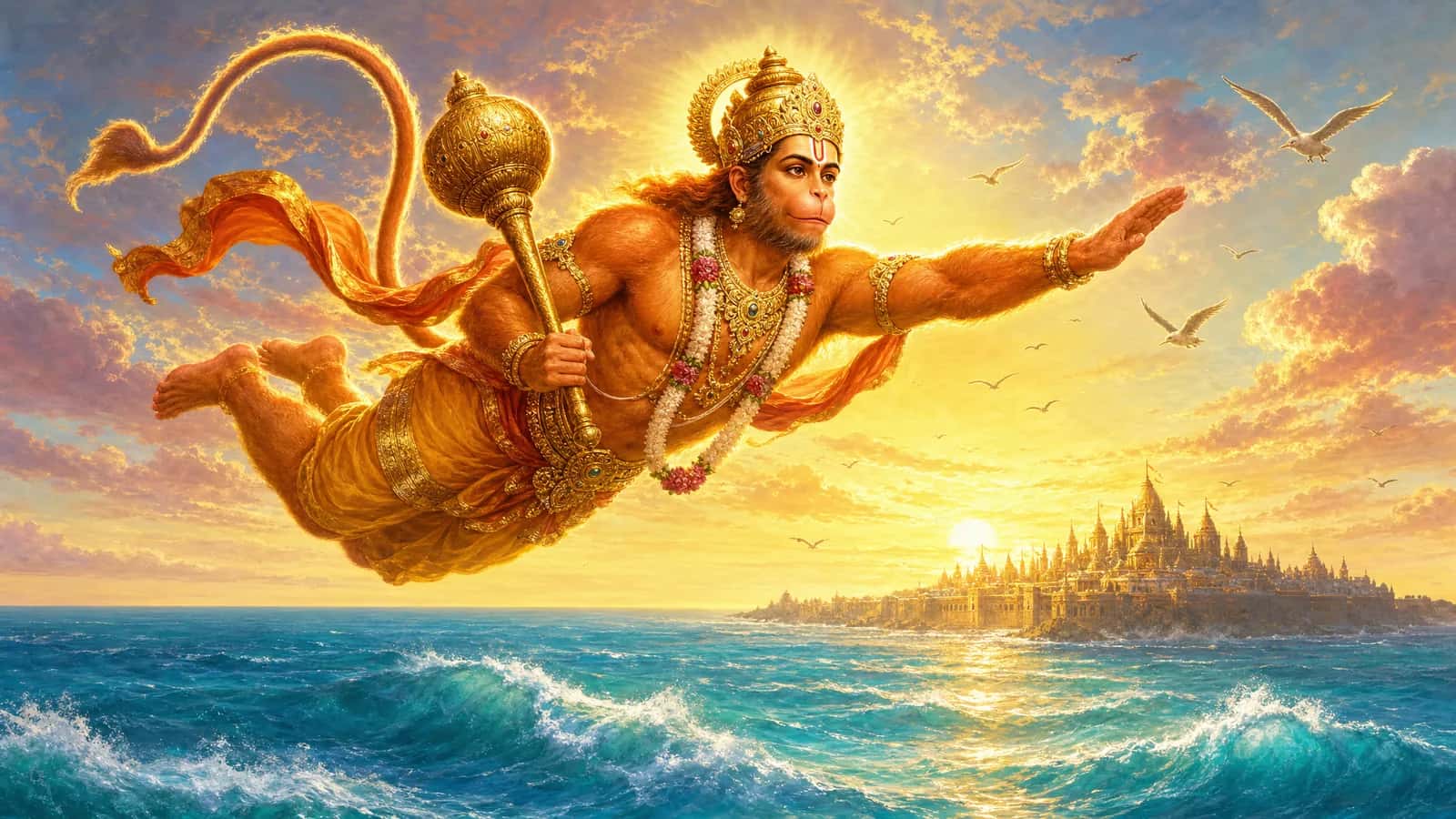
Why Sunderkand is read on its own
So many families recite Sunderkand on its own because this fifth kand of the Ramcharitmanas brings together Hanumanji's service, Mata Sita's steadfastness and Vibhishan's surrender to Shri Ram. Its episodes give us much to contemplate in times of difficulty: how to undertake a hard task, keep the Lord in the heart and place our trust in Him.
Hanumanji leaps across the sea to Lanka, meets Vibhishan and finds Mata Sita in the Ashok Vatika. He gives her Shri Ram's ring. After the burning of Lanka, he returns with her message. The kand then brings us to Vibhishan's surrender and Shri Ram asking the ocean for a way across. Thus, the reading carries us through difficulty towards the next act of service.
Sunderkand is the kand most often recited separately. Families customarily read it on Tuesdays and Saturdays, the days associated with Hanumanji, and during periods of trouble.
The word sundar means beautiful. Traditional explanations connect the name with the beauty of Hanumanji's deeds, the Sundar peak of the Trikuta mountain where Lanka stood, or the beauty of Mata Sita. The text itself does not explain the name. As we read, let us attend to the devotion expressed through these deeds.
How to do Sunderkand paath at home
To do Sunderkand paath at home, choose a clean place, light a lamp and begin with the invocation shlokas. Then read Sunderkand in order, giving attention to the words and their meaning. Keep Shri Ram, Mata Sita and Hanumanji in mind as you read. The purpose is attentive recitation, so allow the reading the time it needs.
Begin with attention. Settle into the place you have prepared and read the invocations without rushing. Let this opening help gather the mind before you enter the events of the kand. There is no need to treat the first lines as something to finish before the reading begins.
Read steadily, without hurry. The whole kand takes about two to three hours read aloud at an unhurried pace. Allow pauses where you need them. For example, when reading an important letter from someone dear to us, we pause over a sentence because we wish to understand it. Similarly, give the words of the paath room to hold your attention.
Divide the reading if needed. Sunderkand can be split across days. If time is limited, stop at a clear point and continue from there the next day. The Ramayan app offers a way to keep reading on the phone and bookmark your place.
End with the aarti when you complete the kand. If the mind wanders during the paath, gently bring it back to the words before you. Give your care to the passage you are reading now.
Invocation
Invocations · Hanumān leaves for Laṅkā, meets Surasā and kills the image-catching demoness
शान्तं शाश्वतमप्रमेयमनघं निर्वाणशान्तिप्रदं ब्रह्माशम्भुफणीन्द्रसेव्यमनिशं वेदान्तवेद्यं विभुम्। रामाख्यं जगदीश्वरं सुरगुरुं मायामनुष्यं हरिं वन्देऽहं करुणाकरं रघुवरं भूपालचूडामणिम्॥ १ ॥
नान्या स्पृहा रघुपते हृदयेऽस्मदीये सत्यं वदामि च भवानखिलान्तरात्मा। भक्तिं प्रयच्छ रघुपुङ्गव निर्भरां मे कामादिदोषरहितं कुरु मानसं च॥ २ ॥
अतुलितबलधामं हेमशैलाभदेहं दनुजवनकृशानुं ज्ञानिनामग्रगण्यम्। सकलगुणनिधानं वानराणामधीशं रघुपतिप्रियभक्तं वातजातं नमामि॥ ३ ॥
Meaning
Śrī Rāmacaritamānasa (The Mānasa lake containing the exploits of Śrī Rāma) Descent Five (Sundara-Kāṇḍa) I adore the Lord of the universe bearing the name of Rāma, the Chief of Raghu’s line and the crest-jewel of kings, the mine of compassion, the dispeller of all sins, appearing in human form through His Māyā (deluding potency), the greatest of all gods, knowable through Vedānta (the Upaniṣads), constantly worshipped by Brahmā (the Creator), Śambhu (Lord Śiva) and Śeṣa (the serpent-god), the bestower of supreme peace in the form of final beatitude, placid, eternal, beyond the ordinary means of cognition, sinless and all-pervading. (1) There is no other craving in my heart, O Śrī Raghunātha: I speak the truth and You are the Spirit indwelling the hearts of all. Grant me intense devotion to Your feet, O crest-jewel of Raghus, and free my mind from faults like concupiscence etc. (2) I bow to Hanumān, the son of the wind-god, the beloved devotee of Śrī Raghunātha, the chief of the monkeys, the repository of all virtues, the foremost among the wise, a fire to consume the forest of the demon race, possessing a body shining as a mountain of gold and a repository of immeasurable strength. (3)
Doha 1
जामवंत के बचन सुहाए। सुनि हनुमंत हृदय अति भाए॥ तब लगि मोहि परिखेहु तुम्ह भाई। सहि दुख कंद मूल फल खाई॥१॥
जब लगि आवौं सीतहि देखी। होइहि काजु मोहि हरष बिसेषी॥ यह कहि नाइ सबन्हि कहुँ माथा। चलेउ हरषि हियँ धरि रघुनाथा॥२॥
सिंधु तीर एक भूधर सुंदर। कौतुक कूदि चढ़ेउ ता ऊपर॥ बार बार रघुबीर सँभारी। तरकेउ पवनतनय बल भारी॥३॥
जेहिं गिरि चरन देइ हनुमंता। चलेउ सो गा पाताल तुरंता॥ जिमि अमोघ रघुपति कर बाना। एही भाँति चलेउ हनुमाना॥४॥
जलनिधि रघुपति दूत बिचारी। तैं मैनाक होहि श्रमहारी॥५॥
Meaning
Hanumān was much delighted at heart to hear the heartening speech of Jāmbavān. He said, “Suffering hardships and living on bulbs, roots and fruits, wait for me, brethren, (1) “till I return after seeing Revered Sītā. I am sure our object will be accomplished as I feel very exuberant.” So saying and after bowing his head to them all, Hanumān set out full of zeal with an image of Śrī Raghunātha enshrined in his heart. (2) There was a beautiful hill on the sea-coast; he lightly sprang on to its top. And invoking Śrī Raghuvīra again and again, the all-powerful Hanumān took a leap with all his might.(3) The hill on which Hanumān planted his foot while leaping sank down immediately into the nethermost region (Pātāla). Hanumān sped forth in the same way as the unerring shaft of Śrī Raghunātha. (4) Knowing him to be Śrī Rāma’s emissary, the deity presiding over the ocean spoke to mount Maināka*, “Relieve him of his fatigue, O Maināka (by letting him rest on you).” (5) * It is mentioned in our scriptures that formerly mountains had wings and could fly like birds, but later on lndra clipped them of their wings by his thunderbolt and since then they became stationary. Maināka, however, who was able to accelerate his speed with the help of the wind-god, rushed into the ocean and hid himself under its waters. The deity presiding over the ocean, who had been begotten by King Sagara, and was thus an ancestor of the Lord, took this opportunity to gratify Śrī Rāma and directed Maināka to come out of his hiding-place and give rest to His envoy in the mid-ocean so as to enable him to cross the ocean by easy stages. Out of gratitude to the ocean, who had afforded him shelter all the time, and in order to repay his obligation to the wind-god, Maināka emerged from his asylum and served as a stepping-stone for Hanumān to rest on and replenish his store of energy. Hanumān, however, who was spurred on by his devotion to Śrī Rāma and depended on His all-sufficient grace, needed no other support and took leave of the mountain by merely acknowledging his services. The incident further shows Hanumān’s unremitting zeal in the service of his Lord.
हनूमान तेहि परसा कर पुनि कीन्ह प्रनाम। राम काजु कीन्हें बिनु मोहि कहाँ बिश्राम॥१॥
Meaning
Hanumān simply touched the mountain with his hand and then made obeisance to it saying, “There can be no rest for me till I have accomplished the task of Śrī Rāma.” (1)
Doha 2
जात पवनसुत देवन्ह देखा। जानैं कहुँ बल बुद्धि बिसेषा॥ सुरसा नाम अहिन्ह कै माता। पठइन्हि आइ कही तेहिं बाता॥१॥
आजु सुरन्ह मोहि दीन्ह अहारा। सुनत बचन कह पवनकुमारा॥ राम काजु करि फिरि मैं आवौं। सीता कइ सुधि प्रभुहि सुनावौं॥२॥
तब तव बदन पैठिहउँ आई। सत्य कहउँ मोहि जान दे माई॥ कवनेहुँ जतन देइ नहिं जाना। ग्रससि न मोहि कहेउ हनुमाना॥३॥
जोजन भरि तेहिं बदनु पसारा। कपि तनु कीन्ह दुगुन बिस्तारा॥ सोरह जोजन मुख तेहिं ठयऊ। तुरत पवनसुत बत्तिस भयऊ॥४॥
जस जस सुरसा बदनु बढ़ावा। तासु दून कपि रूप देखावा॥ सत जोजन तेहिं आनन कीन्हा। अति लघु रूप पवनसुत लीन्हा॥५॥
बदन पइठि पुनि बाहेर आवा। मागा बिदा ताहि सिरु नावा॥ मोहि सुरन्ह जेहि लागि पठावा। बुधि बल मरमु तोर मैं पावा॥६॥
Meaning
The gods saw the son of the wind-god, Hanumān, sweeping along; and in order to test his extraordinary strength and intelligence they sent Surasā, a mother of serpents, who came near him and said: (1) “The gods have provided me a meal today.” On hearing these words, Hanumān said in reply, “Let me return after accomplishing Śrī Rāma’s task and tell my lord the news of Sītā. (2) “Then I will approach you and enter your mouth: I tell you the truth. Mother, only let me go now.” When, however, she would not let him go on any account, Hanumān said, “Then why not devour me?” (3) She distended her mouth to a distance of eight miles, while Hanumān grew double the size of her mouth. She stretched her mouth to a circumference of a hundred and twenty-eight miles, and Hanumān immediately took a form covering two hundred and fifty-six miles. (4) Even as Surasā expanded her jaws, Hanumān manifested a form twice as large as her mouth. When she further expanded her mouth eight hundred miles wide, Hanumān assumed a very minute form, (5) by which he entered her mouth and came out again and bowing his head to her, begged leave to proceed. “I have gauged the extent of your wit and strength, the errand for which the gods had deputed me. (6)
राम काजु सबु करिहहु तुम्ह बल बुद्धि निधान। आसिष देइ गई सो हरषि चलेउ हनुमान॥२॥
Meaning
“You will accomplish all the work of Śrī Rāma, a repository that you are of strength and intelligence.” Having blessed Hanumān she departed and Hanumān too joyfully resumed his journey. (2)
Doha 3
Description of Laṅkā; Hanumān strikes Laṅkinī and enters Laṅkā
निसिचरि एक सिंधु महुँ रहई। करि माया नभु के खग गहई॥ जीव जंतु जे गगन उड़ाहीं। जल बिलोकि तिन्ह कै परिछाहीं॥१॥
गहइ छाहँ सक सो न उड़ाई। एहि बिधि सदा गगनचर खाई॥ सोइ छल हनूमान कहँ कीन्हा। तासु कपटु कपि तुरतहिं चीन्हा॥२॥
ताहि मारि मारुतसुत बीरा। बारिधि पार गयउ मतिधीरा॥ तहाँ जाइ देखी बन सोभा। गुंजत चंचरीक मधु लोभा॥३॥
नाना तरु फल फूल सुहाए। खग मृग बृंद देखि मन भाए॥ सैल बिसाल देखि एक आगें। ता पर धाइ चढ़ेउ भय त्यागें॥४॥
उमा न कछु कपि कै अधिकाई। प्रभु प्रताप जो कालहि खाई॥ गिरि पर चढ़ि लंका तेहिं देखी। कहि न जाइ अति दुर्ग बिसेषी॥५॥
अति उतंग जलनिधि चहु पासा। कनक कोट कर परम प्रकासा॥६॥
Meaning
There was a demoness who dwelt in the ocean and would catch the birds in the air by conjuring tricks. Seeing on the surface of the water the reflection of the creatures that coursed in the air, (1) she would catch it and the bird was unable to move on. In this way she would devour birds every day. She employed the same trick against Hanumān. But Hanumān at once saw through her game. (2) The valiant son of the wind-god, Hanumān, killed her and swept across the ocean, resolute of mind as he was. Reaching the other shore he gazed on the loveliness of the forest with the bees humming in quest of honey. (3) Trees of various kinds looked charming with fruits and flowers; and he was particularly delighted at heart to see the numerous birds and beasts. Beholding a huge mountain ahead of him, he fearlessly ran up to its summit. (4) O Umā, it was no credit for Hanumān, the chief of the monkeys; it was all attributable to the glory of the Lord, who devours Death himself. Climbing up the hill he surveyed Laṅkā, a most marvellous fortress that defied description. (5) It was very high and was enclosed by the ocean on all sides. The ramparts of gold shed great lustre all round. (6)
कनक कोट बिचित्र मनि कृत सुंदरायतना घना। चउहट्ट हट्ट सुबट्ट बीथीं चारु पुर बहु बिधि बना॥ गज बाजि खच्चर निकर पदचर रथ बरूथन्हि को गनै। बहुरूप निसिचर जूथ अतिबल सेन बरनत नहिं बनै॥१॥
बन बाग उपबन बाटिका सर कूप बापीं सोहहीं। नर नाग सुर गंधर्ब कन्या रूप मुनि मन मोहहीं॥ कहुँ माल देह बिसाल सैल समान अतिबल गर्जहीं। नाना अखारेन्ह भिरहिं बहु बिधि एक एकन्ह तर्जहीं॥२॥
करि जतन भट कोटिन्ह बिकट तन नगर चहुँ दिसि रच्छहीं। कहुँ महिष मानुष धेनु खर अज खल निसाचर भच्छहीं॥ एहि लागि तुलसीदास इन्ह की कथा कछु एक है कही। रघुबीर सर तीरथ सरीरन्हि त्यागि गति पैहहिं सही॥३॥
Meaning
The charming city was enclosed by a fortification wall of gold inlaid with precious stones of various kinds, and contained many beautiful houses, cross roads, bazars, lovely streets and lanes, and was decorated in every way. Who could count the multitudes of elephants, horses and mules, the crowds of foot soldiers and chariots and the troops of demons of every shape—a formidable host beyond all description? (1) Groves and orchards, gardens and parks, lakes and also wells, big and small, looked charming; daughters of human beings, Nāgas, gods and Gandharvas (celestial musicians) enraptured with their beauty the minds of even hermits. Here roared mighty wrestlers endowed with huge mountain-like forms. They grappled with one another in many ways in different courts and challenged one another to duel contest. (2) Myriads of champions possessing frightful forms sedulously guarded the city on all sides. Elsewhere the vile demons feasted on buffaloes, human beings, cows, donkeys and goats. Tulasīdāsa has briefly told their story only because they will drop their bodies at the sanctuary of Śrī Rāma’s arrows and thereby attain the supreme state! (3)
पुर रखवारे देखि बहु कपि मन कीन्ह बिचार। अति लघु रूप धरौं निसि नगर करौं पइसार॥३॥
Meaning
Seeing a host of guards defending the city, Hanumān thought to himself, ‘Let me assume a very minute form and enter the city at night.’ (3)
Doha 4
Hanumān meets Vibhīṣaṇa
मसक समान रूप कपि धरी। लंकहि चलेउ सुमिरि नरहरी॥ नाम लंकिनी एक निसिचरी। सो कह चलेसि मोहि निंदरी॥१॥
जानेहि नहीं मरमु सठ मोरा। मोर अहार जहाँ लगि चोरा॥ मुठिका एक महा कपि हनी। रुधिर बमत धरनीं ढनमनी॥२॥
पुनि संभारि उठी सो लंका। जोरि पानि कर बिनय ससंका॥ जब रावनहि ब्रह्म बर दीन्हा। चलत बिरंचि कहा मोहि चीन्हा॥३॥
बिकल होसि तैं कपि कें मारे। तब जानेसु निसिचर संघारे॥ तात मोर अति पुन्य बहूता। देखेउँ नयन राम कर दूता॥४॥
Meaning
Hanumān assumed a form as small as a gnat and, invoking the Lord in human semblance, Bhagavān Śrī Rāma, headed towards Laṅkā. At the gateway of Laṅkā lived a demoness, Laṅkinī by name. “Where should you be going heedless of me?” she said. (1) “Fool, have you not been able to know who I am? Every thief hereabout is my meal.” The great monkey Hanumān dealt her such a blow with his fist that she toppled down vomiting blood. (2) Then, recovering herself, Laṅkā (Laṅkinī), stood up, and folding her hands in dismay, humbly addressed him, “When Brahmā granted Rāvaṇa the boon he had asked for, the Creator furnished me with the following clue to the extermination of the demon race, while departing,— (3) “ ‘When you get discomfited by a blow from a monkey, know that all is over with the demon race.’ I must have earned very great merit (पुण्य), O dear, that I have been blessed with the sight of Śrī Rāma’s own envoy. (4)
तात स्वर्ग अपबर्ग सुख धरिअ तुला एक अंग। तूल न ताहि सकल मिलि जो सुख लव सतसंग॥४॥
Meaning
“In one scale of the balance, my dear, put together the delights of heaven and the bliss of final beatitude; but they will all be outweighed by (placed in the other pan of scale) a moment’s joy derived from communion with saints. (4)
Doha 5
प्रबिसि नगर कीजे सब काजा। हृदयँ राखि कोसलपुर राजा॥ गरल सुधा रिपु करहिं मिताई। गोपद सिंधु अनल सितलाई॥१॥
गरुड़ सुमेरु रेनु सम ताही। राम कृपा करि चितवा जाही॥ अति लघु रूप धरेउ हनुमाना। पैठा नगर सुमिरि भगवाना॥२॥
मंदिर मंदिर प्रति करि सोधा। देखे जहँ तहँ अगनित जोधा॥ गयउ दसानन मंदिर माहीं। अति बिचित्र कहि जात सो नाहीं॥३॥
सयन किएँ देखा कपि तेही। मंदिर महुँ न दीखि बैदेही॥ भवन एक पुनि दीख सुहावा। हरि मंदिर तहँ भिन्न बनावा॥४॥
Meaning
“Enter the city with the Lord of Ayodhyā, Śrī Raghunātha, enshrined in your heart and accomplish all your task.” (Kākabhuṣuṇḍi said:) “Poison is transformed into nectar, foes turn friends, the ocean contracts itself to the size of a cow’s footprint, fire becomes cool,(1) “and Mount Meru, O Garuḍa, appears like a grain of sand to him on whom Śrī Rāma casts His benign look.” Hanumān assumed a very minute form and invoking Śrī Rāma entered the city. (2) He ransacked every mansion and saw countless warriors here and there. Then he made his way into Rāvaṇa’s palace, which was marvellous beyond words. (3) He saw the demon chief buried in sleep; but he did not find Jānakī there. He then noticed another splendid building, with a temple sacred to Śrī Hari, standing apart. (4)
रामायुध अंकित गृह सोभा बरनि न जाइ। नव तुलसिका बृंद तहँ देखि हरष कपिराइ॥५॥
Meaning
The mansion had the weapons (bow and arrow) of Śrī Rāma painted on its walls and was glorious beyond words. The monkey chief, Hanumān, rejoiced to see clusters of young Tulasī plants there. (5)
Doha 6
लंका निसिचर निकर निवासा। इहाँ कहाँ सज्जन कर बासा॥ मन महुँ तरक करैं कपि लागा। तेहीं समय बिभीषनु जागा॥१॥
राम राम तेहिं सुमिरन कीन्हा। हृदयँ हरष कपि सज्जन चीन्हा॥ एहि सन हठि करिहउँ पहिचानी। साधु ते होइ न कारज हानी॥२॥
बिप्र रूप धरि बचन सुनाए। सुनत बिभीषन उठि तहँ आए॥ करि प्रनाम पूँछी कुसलाई। बिप्र कहहु निज कथा बुझाई॥३॥
की तुम्ह हरि दासन्ह महँ कोई। मोरें हृदय प्रीति अति होई॥ की तुम्ह रामु दीन अनुरागी। आयहु मोहि करन बड़भागी॥४॥
Meaning
‘Laṅkā is the abode of multitudes of demons; how could a pious man take up his residence here?’ While Hanumān was thus reasoning within himself, Vibhīṣaṇa (Rāvaṇa’s youngest brother) woke up. (1) He began to repeat Śrī Rāma’s name in prayer and Hanumān was delighted at heart to find a virtuous soul. ‘I shall make acquaintance with him at all events; for one’s cause can never suffer at the hands of a saint.’ (2) Having thus resolved he assumed the form of a Brāhmaṇa and hailed Vibhīṣaṇa. As soon as he heard Hanumān’s words, he rose and came where the latter was. Bowing low he enquired about the Brāhmaṇa’s welfare. Tell me all about you, holy Sir. (3) “Are you one of Śrī Hari’s own servants (Nārada and others)? My heart is filled with exceeding love at your sight. Or, are you Śrī Rāma Himself, a loving friend of the poor, who have come to bless me (by your sight)?” (4)
तब हनुमंत कही सब राम कथा निज नाम। सुनत जुगल तन पुलक मन मगन सुमिरि गुन ग्राम॥६॥
Meaning
Thereupon Hanumān told him all about Śrī Rāma and disclosed his identity as well. The moment Vibhīṣaṇa heard this, a thrill ran through the body of both and they were transported with joy at the thought of Śrī Rāma’s host of virtues. (6)
Doha 7
सुनहु पवनसुत रहनि हमारी। जिमि दसनन्हि महुँ जीभ बिचारी॥ तात कबहुँ मोहि जानि अनाथा। करिहहिं कृपा भानुकुल नाथा॥१॥
तामस तनु कछु साधन नाहीं। प्रीति न पद सरोज मन माहीं॥ अब मोहि भा भरोस हनुमंता। बिनु हरिकृपा मिलहिं नहिं संता॥२॥
जौं रघुबीर अनुग्रह कीन्हा। तौ तुम्ह मोहि दरसु हठि दीन्हा॥ सुनहु बिभीषन प्रभु कै रीती। करहिं सदा सेवक पर प्रीती॥३॥
कहहु कवन मैं परम कुलीना। कपि चंचल सबहीं बिधि हीना॥ प्रात लेइ जो नाम हमारा। तेहि दिन ताहि न मिलै अहारा॥४॥
Meaning
“Hear, O son of the wind-god, how I am living here: my plight is akin to that of the poor tongue that lives in the midst of the teeth. Will the Lord of the solar race, Śrī Rāma, dear friend, ever show His compassion to me, knowing me to be helpless? (1) “Endowed as I am with a sinful (demoniac) form, I am incapable of doing any Sādhanā (striving for God-Realization); and my heart cherishes no love for the Lord’s lotus feet either. But I am now confident, Hanumān, that Śrī Rāma’s grace is on me, for one can never meet a saint without Śrī Hari’s grace. (2) “It is only because Śrī Raghuvīra is kind to me that you have blessed me with your meeting unsolicited.” “Listen, Vibhīṣaṇa, the Lord is ever affectionate to His servants; for such is His wont. (3) “Tell me what superior birth can I claim—a frivolous monkey, vile in every way, so much so that if anyone mentions our name early in the morning he is sure to go without any food that day. (4)
अस मैं अधम सखा सुनु मोहू पर रघुबीर। कीन्ही कृपा सुमिरि गुन भरे बिलोचन नीर॥७॥
Meaning
“Listen, my friend, though I am so wretched, Śrī Rāma has shown His grace even to me!” And Hanumān’s eyes filled with tears as he recalled the Lord’s virtues. (7)
Doha 8
Hanumān’s grief at the sight of Sītā in the Aśoka grove and Rāvaṇa’s threat to Sītā
जानतहूँ अस स्वामि बिसारी। फिरहिं ते काहे न होहिं दुखारी॥ एहि बिधि कहत राम गुन ग्रामा। पावा अनिर्बाच्य बिश्रामा॥१॥
पुनि सब कथा बिभीषन कही। जेहि बिधि जनकसुता तहँ रही॥ तब हनुमंत कहा सुनु भ्राता। देखी चहउँ जानकी माता॥२॥
जुगुति बिभीषन सकल सुनाई। चलेउ पवनसुत बिदा कराई॥ करि सोइ रूप गयउ पुनि तहवाँ। बन असोक सीता रह जहवाँ॥३॥
देखि मनहि महुँ कीन्ह प्रनामा। बैठेहिं बीति जात निसि जामा॥ कृस तनु सीस जटा एक बेनी। जपति हृदयँ रघुपति गुन श्रेनी॥४॥
Meaning
“It is not to be wondered that those who knowingly forget such a lord (Śrī Raghunātha) and go adrift should be unhappy.” Thus recounting Śrī Rāma’s virtues, Hanumān derived supreme solace. (1) Then Vibhīṣaṇa fully narrated how Jānakī had been living there. Thereupon Hanumān said, “Listen, brother, I should like to see Mother Jānakī.” (2) Vibhīṣaṇa fully explained to him the strategy of seeing Her. Hanumān took leave of Vibhīṣaṇa and proceeded on his errand. Assuming the same minute form as he had taken before, he repaired to the Aśoka grove where Sītā had been lodged. (3) He mentally bowed to Her as soon as he saw Her. Obviously She had been squatting away the hours of the night. Emaciated in body, She wore a single braid* of matted hair on Her head and repeated to Herself the host of Śrī Rāma’s virtues. (4) * It is customary with Indian women to wear a single braid of hair when separated from their husband.
निज पद नयन दिएँ मन राम पद कमल लीन। परम दुखी भा पवनसुत देखि जानकी दीन॥८॥
Meaning
She had Her eyes fixed on Her own feet, while Her mind was absorbed in the thought of Śrī Rāma’s lotus feet. The son of the wind-god, Hanumān, felt extremely miserable to see Jānakī so disconsolate. (8)
Doha 9
तरु पल्लव महुँ रहा लुकाई। करइ बिचार करौं का भाई॥ तेहि अवसर रावनु तहँ आवा। संग नारि बहु किएँ बनावा॥१॥
बहु बिधि खल सीतहि समुझावा। साम दान भय भेद देखावा॥ कह रावनु सुनु सुमुखि सयानी। मंदोदरी आदि सब रानी॥२॥
तव अनुचरीं करउँ पन मोरा। एक बार बिलोकु मम ओरा॥ तृन धरि ओट कहति बैदेही। सुमिरि अवधपति परम सनेही॥३॥
सुनु दसमुख खद्योत प्रकासा। कबहुँ कि नलिनी करइ बिकासा॥ अस मन समुझु कहति जानकी। खल सुधि नहिं रघुबीर बान की॥४॥
सठ सूनें हरि आनेहि मोही। अधम निलज्ज लाज नहिं तोही॥५॥
Meaning
Concealing himself among the leaves of a tree he mused within himself, “O Brother! what should I do?” At that very moment Rāvaṇa arrived there, gaily adorned and accompanied by a large number of women. (1) The wretch tried to prevail upon Her in many ways—through friendly advice, allurements, threats and estrangement. Said Rāvaṇa, “Listen, O beautiful and wise lady: I will make Mandodarī and all other queens, (2) “your handmaids, I swear, provided you do cast a look on me only once.” Interposing* a blade of grass between Herself and Rāvaṇa and fixing Her thoughts on Her most beloved lord Śrī Rāma, the King of Ayodhyā, Jānakī rejoined,— (3) * According to the Hindu etiquette a lady must not talk to a male stranger without a medium. Being forced to violate the above rule at this emergency, Sītā takes recourse to the aforesaid expedient. “Listen, O ten-headed monster, can a lotus flower ever bloom in the glow of a fire-fly?” “Ponder this at heart,” continued Jānakī, “perhaps you have no idea what Śrī Rāma’s shafts are like, O wretch. (4) “You carried me off at a time when there was none by my side; yet you do not feel ashamed, O vile and shameless rogue!” (5)
आपुहि सुनि खद्योत सम रामहि भानु समान। परुष बचन सुनि काढ़ि असि बोला अति खिसिआन॥९॥
Meaning
Hearing himself likened to a glow-worm and Śrī Rāma compared to the sun, and exasperated at Her stinging words, the monster drew out his sword and said: (9)
Doha 10
Dialogue between Sītā and Trijaṭā
सीता तैं मम कृत अपमाना। कटिहउँ तव सिर कठिन कृपाना॥ नाहिं त सपदि मानु मम बानी। सुमुखि होति न त जीवन हानी॥१॥
स्याम सरोज दाम सम सुंदर। प्रभु भुज करि कर सम दसकंधर॥ सो भुज कंठ कि तव असि घोरा। सुनु सठ अस प्रवान पन मोरा॥२॥
चंद्रहास हरु मम परितापं। रघुपति बिरह अनल संजातं॥ सीतल निसित बहसि बर धारा। कह सीता हरु मम दुख भारा॥३॥
सुनत बचन पुनि मारन धावा। मयतनयाँ कहि नीति बुझावा॥ कहेसि सकल निसिचरिन्ह बोलाई। सीतहि बहु बिधि त्रासहु जाई॥४॥
मास दिवस महुँ कहा न माना। तौ मैं मारबि काढ़ि कृपाना॥५॥
Meaning
“Sītā, you have hurled insults at me; I will accordingly cut off your head with my relentless sword. Either obey my command at once, or else you will lose your life, O beautiful lady.” (1) “My lord’s arm is lovely as a string of blue lotuses and shapely and long as the trunk of an elephant, O ten-headed monster. Either that arm or your dreadful sword will have my neck: hear this my solemn vow, O fool. (2) (Turning to Rāvaṇa’s glittering scimitar) “Take away, O Candrahāsa*, the burning anguish of my heart caused by the fire of separation from Śrī Raghunātha. You possess a cool, sharp and good blade; therefore, relieve the burden of my sorrow,” Sītā said.(3) * The word literally means ‘That which derides the moon by its cool brilliance’. Though generally used as a synonym for a curved sword, it particularly denotes the sword possessed by Rāvaṇa as a gift from Bhagavān Śaṅkara, to whom it originally belonged. In Her utter despair Sītā looked to Rāvaṇa’s sword alone to come to Her rescue and end Her miserable existence; and the sword, though cruel and dreadful to all appearance, appeared to Her as agreeable and soothing as the moon’s rays to a burning heart. The appellation ‘Candrahāsa’ thus sounded most appropriate to Her. On hearing these words he rushed forward to kill Her; it was Queen Mandodarī (Maya’s daughter) who (intervened and) pacified him with words of good counsel. Summoning all the demonesses (posted there) he said, “Go and intimidate Sītā in every way. (4) “If she does not accept my directive in a month’s time, I will draw my sword and behead her.” (5)
भवन गयउ दसकंधर इहाँ पिसाचिनि बृंद। सीतहि त्रास देखावहिं धरहिं रूप बहु मंद॥१०॥
Meaning
(Having issued these instructions) the ten-headed Rāvaṇa returned to his palace; while the host of fiendesses in the Aśoka grove assumed various kinds of hideous forms and intimidated Sītā. (10)
Doha 11
त्रिजटा नाम राच्छसी एका। राम चरन रति निपुन बिबेका॥ सबन्हौ बोलि सुनाएसि सपना। सीतहि सेइ करहु हित अपना॥१॥
सपनें बानर लंका जारी। जातुधान सेना सब मारी॥ खर आरूढ़ नगन दससीसा। मुंडित सिर खंडित भुज बीसा॥२॥
एहि बिधि सो दच्छिन दिसि जाई। लंका मनहुँ बिभीषन पाई॥ नगर फिरी रघुबीर दोहाई। तब प्रभु सीता बोलि पठाई॥३॥
यह सपना मैं कहउँ पुकारी। होइहि सत्य गएँ दिन चारी॥ तासु बचन सुनि ते सब डरीं। जनकसुता के चरनन्हि परीं॥४॥
Meaning
One of these demonesses, Trijaṭā by name, was devoted to Śrī Rāma’s feet and was perfect in dispassionate wisdom. She summoned all her companions, told them of her dream and exhorted them to serve Sītā and thus be blessed: (1) “In my dream a monkey burnt Laṅkā and the whole demon host was killed. As for the ten-headed Rāvaṇa, I saw him mounted on a donkey, all naked, with his heads shorn and his twenty arms chopped off. (2) “In this manner he went his way to the south*; and it so appeared that Laṅkā had passed into the hands of Vibhīṣaṇa. Śrī Rāma’s victory was proclaimed (by beat of drum) throughout the city: it was then that the Lord, Śrī Rāma, sent for Sītā. (3) * The abode of Yama (the god of death) is believed to be in the south. That is why journey in a dream to the south is supposed to forebode death. “This dream, I loudly proclaim, will come true a few days hence.” They were all dismayed to hear her words and fell at the feet of Jānakī. (4)
जहँ तहँ गईं सकल तब सीता कर मन सोच। मास दिवस बीतें मोहि मारिहि निसिचर पोच॥११॥
Meaning
Then they all dispersed in various directions and Sītā anxiously thought within Herself: ‘At the end of a long month this vile monster will slay me.’† (11) † As appears from what follows, it is not death that Sītā dreads, but the long interval of a month which has to elapse before Her threatened death.
Doha 12
Dialogue between Sītā and Hanumān
त्रिजटा सन बोलीं कर जोरी। मातु बिपति संगिनि तैं मोरी॥ तजौं देह करु बेगि उपाई। दुसह बिरहु अब नहिं सहि जाई॥१॥
आनि काठ रचु चिता बनाई। मातु अनल पुनि देहि लगाई॥ सत्य करहि मम प्रीति सयानी। सुनै को श्रवन सूल सम बानी॥२॥
सुनत बचन पद गहि समुझाएसि। प्रभु प्रताप बल सुजसु सुनाएसि॥ निसि न अनल मिल सुनु सुकुमारी। अस कहि सो निज भवन सिधारी॥३॥
कह सीता बिधि भा प्रतिकूला। मिलिहि न पावक मिटिहि न सूला॥ देखिअत प्रगट गगन अंगारा। अवनि न आवत एकउ तारा॥४॥
पावकमय ससि स्रवत न आगी। मानहुँ मोहि जानि हत भागी॥ सुनहि बिनय मम बिटप असोका। सत्य नाम करु हरु मम सोका॥५॥
नूतन किसलय अनल समाना। देहि अगिनि जनि करहि निदाना॥ देखि परम बिरहाकुल सीता। सो छन कपिहि कलप सम बीता॥६॥
Meaning
With folded hands She said to Trijaṭā, “Mother, you are my only companion in adversity. Therefore, quickly devise some means whereby I may be enabled to cast off this body; for this desolation, which is so hard to bear, can no longer be endured. (1) “Bring some wood and put up a pyre; and then, my mother, set fire to it, and thus prove the genuineness of my love for the Lord, O wise lady. Who will stand Rāvaṇa’s words that pierce the ears like a shaft?” (2) On hearing these words Trijaṭā clasped Sītā’s feet and comforted Her by recounting the majesty, might and glory of Her lord. “Listen, O tender lady: no fire can be had at night.” So saying, she left for her residence. (3) Sītā said (to Herself) ‘Heaven itself has turned hostile to me; there is no fire to be had and I cannot be cured of my agony otherwise. Sparks of fire are visibly seen in the heavens; but not a single star drops to the earth. (4) ‘The moon, though all fire, refuses to rain sparks, as if conscious of my wretchedness. Listen to my prayer, O Aśoka tree*: take away my sorrow and be true to your name. (5) * The word ‘Aśoka’ literally means that which ends sorrow. ‘Your fresh and tender leaves bear the colour of flames; therefore, supply me with fire and do not aggravate my agony beyond limits.’ The moment seemed like an age† to Hanumān as he beheld Sītā extremely distressed (due to Her separation from Her lord). (6) † Literally speaking, the world ‘Kalpa’ denotes the span of life of the universe, which has been calculated to cover 4,32,00,000 years.
कपि करि हृदयँ बिचार दीन्हि मुद्रिका डारि तब। जनु असोक अंगार दीन्ह हरषि उठि कर गहेउ॥१२॥
Meaning
Then, thinking deeply within himself Hanumān dropped down the signet ring, as though the Aśoka tree had thrown a spark (in response to Her prayer). She sprang up with joy and took it in Her hand. (12)
Doha 13
तब देखी मुद्रिका मनोहर। राम नाम अंकित अति सुंदर॥ चकित चितव मुदरी पहिचानी। हरष बिषाद हृदयँ अकुलानी॥१॥
जीति को सकइ अजय रघुराई। माया तें असि रचि नहिं जाई॥ सीता मन बिचार कर नाना। मधुर बचन बोलेउ हनुमाना॥२॥
रामचंद्र गुन बरनैं लागा। सुनतहिं सीता कर दुख भागा॥ लागीं सुनैं श्रवन मन लाई। आदिहु तें सब कथा सुनाई॥३॥
श्रवनामृत जेहिं कथा सुहाई। कही सो प्रगट होति किन भाई॥ तब हनुमंत निकट चलि गयऊ। फिरि बैठीं मन बिसमय भयऊ॥४॥
राम दूत मैं मातु जानकी। सत्य सपथ करुनानिधान की॥ यह मुद्रिका मातु मैं आनी। दीन्हि राम तुम्ह कहँ सहिदानी॥५॥
नर बानरहि संग कहु कैसें। कही कथा भइ संगति जैसें॥६॥
Meaning
Now She saw the charming ring with the name of ‘Rāma’ most beautifully engraved on it. Recognizing the ring She looked at it with wonder and was agitated at heart with a mixed feeling of joy and sorrow. (1) ‘Who can conquer the invincible Śrī Raghunātha and such a divine ring cannot be wrought through Māyā (a conjuring trick).’ As Sītā thus indulged in fancies of various kinds, Hanumān spoke in sweet accents, (2) and began to recount Śrī Rāmacandra’s glories, hearing which Sītā’s grief disappeared. She listened with all Her mind and ears while Hanumān narrated the whole story from the very beginning. (3) “Wherefore does he, who has told this tale, which is like nectar to my ears, not reveal himself?”* Thereupon Hanumān drew near Her, while Sītā sat with her back turned towards him, full of amazement. (4) * Obviously the orchard in which Sītā had been confined was open to the fair sex alone. Naturally, therefore, when She heard an unseen voice utter Śrī Rāma’s praises, She concluded that it must be some female. “I am Śrī Rāma’s messenger, mother Jānakī: I solemnly swear by the all-merciful Lord Himself. This ring has been brought by me, O mother; Śrī Rāma gave it to me as a token of my identification for you.” (5) “Tell me what brought about this fellowship between a man and a monkey.” Then Hanumān explained the circumstances in which the union had been brought about (between Śrī Rāma and the monkeys). (6)
कपि के बचन सप्रेम सुनि उपजा मन बिस्वास। जाना मन क्रम बचन यह कृपासिंधु कर दास॥१३॥
Meaning
As Sītā heard Hanumān’s affectionate words, She trusted him and She recognized him to be a servant of the all-merciful Śrī Raghunātha in thought, word and deed. (13)
Doha 14
हरिजन जानि प्रीति अति गाढ़ी। सजल नयन पुलकावलि बाढ़ी॥ बूड़त बिरह जलधि हनुमाना। भयहु तात मो कहुँ जलजाना॥ १॥
अब कहु कुसल जाउँ बलिहारी। अनुज सहित सुख भवन खरारी॥ कोमलचित कृपाल रघुराई। कपि केहि हेतु धरी निठुराई॥२॥
सहज बानि सेवक सुखदायक। कबहुँक सुरति करत रघुनायक॥ कबहुँ नयन मम सीतल ताता। होइहहिं निरखि स्याम मृदु गाता॥३॥
बचनु न आव नयन भरे बारी। अहह नाथ हौं निपट बिसारी॥ देखि परम बिरहाकुल सीता। बोला कपि मृदु बचन बिनीता॥४॥
मातु कुसल प्रभु अनुज समेता। तव दुख दुखी सुकृपा निकेता॥ जनि जननी मानहु जियँ ऊना। तुम्ह ते प्रेमु राम कें दूना॥५॥
Meaning
Perceiving him to be a devotee of Śrī Hari, She developed an intense affection for him. Her eyes filled with tears and a thrill ran through Her body. “To me, who was being drowned in the ocean of desolation, dear Hanumān, you have come as a veritable bark. (1) “Now tell me, I adjure you, the welfare of all-blissful Śrī Rāma and His younger brother, Lakṣmaṇa. Wherefore has the tender-hearted and compassionate Śrī Raghunātha become so hard-hearted? (2) “Does Śrī Raghunātha ever remember me—He who by natural disposition is a source of delight to His servants? Will my eyes, dear Hanumān, be ever soothed by the sight of His swarthy and delicate limbs?” (3) Words failed Her and Her eyes swam with tears. ‘Ah, my lord! You have entirely forgotten me.’ Seeing Sītā sore distressed due to Her separation from Her lord, Hanumān addressed Her in soft and polite accents: (4) “The Lord and His younger brother Lakṣmaṇa are both doing well, mother, except for the fact that the all-merciful is sorrowful because of Your sorrow. Do not feel disconsolate at heart, mother; Śrī Rāma loves You twice as much as You love Him.(5)
रघुपति कर संदेसु अब सुनु जननी धरि धीर। अस कहि कपि गदगद भयउ भरे बिलोचन नीर॥१४॥
Meaning
“Mother, compose Yourself now and hear the message of Śrī Raghunātha.” Even as he uttered these words, Hanumān’s voice got choked with emotion and his eyes were filled with tears, (14)
Doha 15
कहेउ राम बियोग तव सीता। मो कहुँ सकल भए बिपरीता॥ नव तरु किसलय मनहुँ कृसानू। कालनिसा सम निसि ससि भानू॥१॥
कुबलय बिपिन कुंतबन सरिसा। बारिद तपत तेल जनु बरिसा॥ जे हित रहे करत तेइ पीरा। उरग स्वास सम त्रिबिध समीरा॥२॥
कहेहू तें कछु दुख घटि होई। काहि कहौं यह जान न कोई॥ तत्व प्रेम कर मम अरु तोरा। जानत प्रिया एकु मनु मोरा॥३॥
सो मनु सदा रहत तोहि पाहीं। जानु प्रीति रसु एतनेहि माहीं॥ प्रभु संदेसु सुनत बैदेही। मगन प्रेम तन सुधि नहिं तेही॥४॥
कह कपि हृदयँ धीर धरु माता। सुमिरु राम सेवक सुखदाता॥ उर आनहु रघुपति प्रभुताई। सुनि मम बचन तजहु कदराई॥५॥
Meaning
“Śrī Rāma has said: ‘Ever since I have been separated from you, Sītā, everything to me has become perverse. The fresh and tender leaves on the trees look like tongues of fire; nights appear as dreadful as the night of final dissolution and the moon scorches like the sun. (1) ‘Beds of lotuses are like so many spears planted on the ground, while rain-clouds pour boiling oil, as it were. Those that were friendly before have now become tormenting; the cool, soft and fragrant breezes are now like the breath of a serpent, poisonous and hot. (2) ‘One’s agony is assuaged to some extent even by speaking of it; but to whom shall I speak about it? For there is no one who will understand. The reality about the chord of love that binds you and me, dear, is known to my mind alone. (3) ‘And my mind ever abides in you. Know this to be the essence of my love.’ ” Jānakī was so absorbed in love the moment She heard the Lord’s message that She lost all consciousness of Her body. (4) Said Hanumān, “Mother, compose Yourself, and fix Your thoughts on Śrī Rāma, the delight of His servants. Reflect on the glory of Śrī Raghunātha and shake off all faint-heartedness upon my word. (5)
निसिचर निकर पतंग सम रघुपति बान कृसानु। जननी हृदयँ धीर धरु जरे निसाचर जानु॥१५॥
Meaning
“The hosts of demons are like so many moths, while the shafts of Śrī Raghunātha are like flames. Have courage in Your heart, mother, and take the demons as burnt. (15)
Doha 16
जौं रघुबीर होति सुधि पाई। करते नहिं बिलंबु रघुराई॥ राम बान रबि उएँ जानकी। तम बरूथ कहँ जातुधान की॥ १॥
अबहिं मातु मैं जाउँ लवाई। प्रभु आयसु नहिं राम दोहाई॥ कछुक दिवस जननी धरु धीरा। कपिन्ह सहित अइहहिं रघुबीरा॥२॥
निसिचर मारि तोहि लै जैहहिं। तिहुँ पुर नारदादि जसु गैहहिं॥ हैं सुत कपि सब तुम्हहि समाना। जातुधान अति भट बलवाना॥३॥
मोरें हृदय परम संदेहा। सुनि कपि प्रगट कीन्हि निज देहा॥ कनक भूधराकार सरीरा। समर भयंकर अतिबल बीरा॥४॥
सीता मन भरोस तब भयऊ। पुनि लघु रूप पवनसुत लयऊ॥५॥
Meaning
“Had Śrī Rāma any news about You, He would not have tarried. The moment Śrī Rāma’s arrows make their appearance like the sun, the demon host would be scattered like the darkness of night. (1) “Mother, I could take You to Him this very moment; but, I swear by Śrī Rāma, I have no such orders from the Lord. Therefore, wait patiently for some days more, mother, till Śrī Rāma arrives with the troops of monkeys. (2) “Slaughtering the demons, He will take You away, while Nārada and the other sages will glorify Him in all the three spheres.” “But, my son, all the monkeys must be pygmies like you, whereas the demons are mighty and great warriors. (3) “I have grave misgivings in my heart on this score.” On hearing this, Hanumān revealed His natural form, colossal as a mountain of gold, causing dread in the hearts of enemies, mighty and full of valour. (4) Sītā now felt reassured in Her mind and Hanumān thereupon resumed his diminutive appearance. (5)
सुनु माता साखामृग नहिं बल बुद्धि बिसाल। प्रभु प्रताप तें गरुड़हि खाइ परम लघु ब्याल॥१६॥
Meaning
“Listen, mother, monkeys possess no great strength or intelligence either; but through the Lord’s glory, the most tiny snake can swallow Garuḍa (the king of birds and the mount of Bhagavān Viṣṇu).” (16)
Doha 17
Hanumān lays waste the Aśoka grove and kills prince Akṣaya; at last Meghanāda entangles Hanumān in a noose of Brahmā and carries him off to Rāvaṇa’s court
मन संतोष सुनत कपि बानी। भगति प्रताप तेज बल सानी॥ आसिष दीन्हि रामप्रिय जाना। होहु तात बल सील निधाना॥१॥
अजर अमर गुननिधि सुत होहू। करहुँ बहुत रघुनायक छोहू॥ करहुँ कृपा प्रभु अस सुनि काना। निर्भर प्रेम मगन हनुमाना॥२॥
बार बार नाएसि पद सीसा। बोला बचन जोरि कर कीसा॥ अब कृतकृत्य भयउँ मैं माता। आसिष तव अमोघ बिख्याता॥३॥
सुनहु मातु मोहि अतिसय भूखा। लागि देखि सुंदर फल रूखा॥ सुनु सुत करहिं बिपिन रखवारी। परम सुभट रजनीचर भारी॥४॥
तिन्ह कर भय माता मोहि नाहीं। जौं तुम्ह सुख मानहु मन माहीं॥५॥
Meaning
Sītā felt gratified at heart even as She heard Hanumān’s words, full of devotion and revealing Śrī Rāma’s majesty, glory and strength. Recognizing him as the beloved of Śrī Rāma She gave him Her blessings: “May you become a repository of strength and virtue, dear child. (1) “May you ever remain immune from old age and death and prove to be an epitome of good qualities, my son; and may Śrī Raghunātha shower His profuse benevolence on you.” The moment the words ‘May the Lord be benevolent to you’ reached his ears, Hanumān was completely overwhelmed with emotion. (2) Again and again Hanumān bowed his head at Her feet and with folded hands addressed Her thus: “I have now accomplished all that I had to, my mother; for your blessing, as is well-known, is unfailing. (3) “Listen, mother, I am feeling extremely hungry at the sight of these trees laden with delicious fruits.” (Said Jānakī): “I tell you, my son, this grove is guarded by most valiant and mighty demons.” (4) “Mother, I am not at all afraid of them, only if I have your hearty approval.” (5)
देखि बुद्धि बल निपुन कपि कहेउ जानकीं जाहु। रघुपति चरन हृदयँ धरि तात मधुर फल खाहु॥१७॥
Meaning
Seeing Hanumān perfect in strength and wisdom, Jānakī said, “Go, my son, and enjoy the luscious fruit with your heart fixed on Śrī Rāma’s feet.” (17)
Doha 18
चलेउ नाइ सिरु पैठेउ बागा। फल खाएसि तरु तोरैं लागा॥ रहे तहाँ बहु भट रखवारे। कछु मारेसि कछु जाइ पुकारे॥१॥
नाथ एक आवा कपि भारी। तेहिं असोक बाटिका उजारी॥ खाएसि फल अरु बिटप उपारे। रच्छक मर्दि मर्दि महि डारे॥२॥
सुनि रावन पठए भट नाना। तिन्हहि देखि गर्जेउ हनुमाना॥ सब रजनीचर कपि संघारे। गए पुकारत कछु अधमारे॥३॥
पुनि पठयउ तेहिं अच्छकुमारा। चला संग लै सुभट अपारा॥ आवत देखि बिटप गहि तर्जा। ताहि निपाति महाधुनि गर्जा॥४॥
Meaning
Bowing his head he went forth and entered the grove; and having eaten the fruit he began to break down the trees. A number of warriors had been posted there as guards; some of them were killed by him, while the rest took flight to Rāvaṇa and cried for protection, (1) “O lord, a huge monkey has made his appearance and laid waste the Aśoka grove. He has eaten fruits, uprooted trees, and, having crushed the watchmen, has laid them on the ground.” (2) On hearing this, Rāvaṇa despatched a number of his warriors. Hanumān roared when he saw them and slaughtered the whole demon host. A few that survived, though well-nigh killed, escaped screaming. (3) Rāvaṇa then sent prince Akṣa, who sallied forth with a vast number of his best warriors. Seeing them approach, Hanumān seized a tree and threatened them and, having killed the prince, roared loudly. (4)
कछु मारेसि कछु मर्देसि कछु मिलएसि धरि धूरि। कछु पुनि जाइ पुकारे प्रभु मर्कट बल भूरि॥१८॥
Meaning
Some he slew, some he crushed and some he seized and pounded with dust. And some, who escaped, cried, “O lord, the monkey is too strong and formidable for us.” (18)
Doha 19
सुनि सुत बध लंकेस रिसाना। पठएसि मेघनाद बलवाना॥ मारसि जनि सुत बाँधेसु ताही। देखिअ कपिहि कहाँ कर आही॥१॥
चला इंद्रजित अतुलित जोधा। बंधु निधन सुनि उपजा क्रोधा॥ कपि देखा दारुन भट आवा। कटकटाइ गर्जा अरु धावा॥२॥
अति बिसाल तरु एक उपारा। बिरथ कीन्ह लंकेस कुमारा॥ रहे महाभट ताके संगा। गहि गहि कपि मर्दइ निज अंगा॥३॥
तिन्हहि निपाति ताहि सन बाजा। भिरे जुगल मानहुँ गजराजा॥ मुठिका मारि चढ़ा तरु जाई। ताहि एक छन मुरुछा आई॥४॥
उठि बहोरि कीन्हिसि बहु माया। जीति न जाइ प्रभंजन जाया॥५॥
Meaning
Rāvaṇa flew into a rage when he heard of his son’s death and sent the mighty Meghanāda. “Kill him not, my son, but bind him. Let us see the monkey and ascertain wherefrom he comes.” (1) Meghanāda, the conqueror of lndra, sallied forth, a peerless champion, seized with fury at the news of his brother’s death. When Hanumān saw this fierce warrior approach, he gnashed his teeth and with a roar rushed forward to meet him. (2) He tore up a tree of enormous size and smashed with it the chariot, thus rendering the crown prince of Laṅkā, Meghanāda, without any vehicle. As for the mighty warriors who accompanied him, Hanumān seized them one by one and crushed them by rubbing them against his body. (3) Having finished them off, he closed with Meghanāda. It was like the encounter of two lordly elephants. Striking the opponent with his clenched fist, Hanumān sprang and climbed up a tree; while Meghanāda lay unconscious for a moment. (4) He rose again and resorted to many a delusive device; but the son of the wind-god was not the one to be vanquished. (5)
ब्रह्म अस्त्र तेहिं साँधा कपि मन कीन्ह बिचार। जौं न ब्रह्मसर मानउँ महिमा मिटइ अपार॥१९॥
Meaning
Meghanāda ultimately put to his bow the arrow known as Brahmāstra (the weapon presided over by Brahmā), when Hanumān thought within himself: ‘If I submit not to Brahmā’s own weapon, its infinite glory will be lost.’ (19)
Doha 20
Dialogue between Hanumān and Rāvaṇa
ब्रह्मबान कपि कहुँ तेहिं मारा। परतिहुँ बार कटकु संघारा॥ तेहिं देखा कपि मुरुछित भयऊ। नागपास बाँधेसि लै गयऊ॥१॥
जासु नाम जपि सुनहु भवानी। भव बंधन काटहिं नर ग्यानी॥ तासु दूत कि बंध तरु आवा। प्रभु कारज लगि कपिहिं बँधावा॥२॥
कपि बंधन सुनि निसिचर धाए। कौतुक लागि सभाँ सब आए॥ दसमुख सभा दीखि कपि जाई। कहि न जाइ कछु अति प्रभुताई॥३॥
कर जोरें सुर दिसिप बिनीता। भृकुटि बिलोकत सकल सभीता॥ देखि प्रताप न कपि मन संका। जिमि अहिगन महुँ गरुड़ असंका॥४॥
Meaning
Meghanāda launched the Brahmāstra against Hanumān, who crushed a whole host of warriors even as he fell. When he saw that the monkey had swooned, he entangled the latter in a serpentine* noose and carried him off. (1) * A special contrivance to entangle the enemy, possessed by Varuṇa (the god presiding over the waters) and evidently snatched from the latter by Rāvaṇa. Now, Pārvatī, is it conceivable that the envoy of the Lord, whose very name enables the wise to cut asunder the bonds of mundane existence, should come under bondage? No, it was in the service of the Lord that Hanumān allowed himself to be bound. (2) When the demons heard that the monkey had been captured and bound, they all rushed to the court in order to enjoy the spectacle. Hanumān arrived and saw Rāvaṇa’s court: his superb glory baffled description. (3) Even gods and regents of the quarters stood humbled with folded hands, all watching the movement of his eyebrows in great dismay. But Hanumān was no more disturbed at the sight of his grandeur than Garuḍa (the king of birds) would be frightened in the midst of a number of serpents. (4)
कपिहि बिलोकि दसानन बिहसा कहि दुर्बाद। सुत बध सुरति कीन्हि पुनि उपजा हृदयँ बिषाद॥२०॥
Meaning
When the ten-headed monster saw Hanumān, he laughed and railed at him. But presently he recalled his son’s death and was grieved at heart. (20)
Doha 21
कह लंकेस कवन तैं कीसा। केहि कें बल घालेहि बन खीसा॥ की धौं श्रवन सुनेहि नहिं मोही। देखउँ अति असंक सठ तोही॥१॥
मारे निसिचर केहिं अपराधा। कहु सठ तोहि न प्रान कइ बाधा॥ सुनु रावन ब्रह्मांड निकाया। पाइ जासु बल बिरचति माया॥२॥
जाकें बल बिरंचि हरि ईसा। पालत सृजत हरत दससीसा॥ जा बल सीस धरत सहसानन। अंडकोस समेत गिरि कानन॥३॥
धरइ जो बिबिध देह सुरत्राता। तुम्ह से सठन्ह सिखावनु दाता॥ हर कोदंड कठिन जेहिं भंजा। तेहि समेत नृप दल मद गंजा॥४॥
खर दूषन त्रिसिरा अरु बाली। बधे सकल अतुलित बलसाली॥५॥
Meaning
Said the king of Laṅkā, “Who are you, O monkey, and on whose might have you wrought the destruction of the grove? What! have you never heard my name? I see you are a wholly fearless wretch. (1) “For what offence did you kill the demons? Tell me, fool, are you not afraid of losing your life?” (Said Hanumān): “Listen, Rāvaṇa: recall Him by whose might Māyā (Prakṛti/Nature) brings forth innumerable universes, (2) “by whose might, O ten-headed monster, Brahmā, Hari (Viṣṇu) and Īśa (Śiva) carry on their respective function of creation, preservation and destruction; by whose might the thousand headed serpent (Śeṣa) supports on his head the entire globe with its mountains and forests, (3) “who assumes various forms in order to protect the gods and teach a lesson to wretches like you; who broke Śiva’s unbending bow and crushed with it the pride of a host of princes, (4) “who killed Khara, Dūṣaṇa, Triśirā and Bāli, all unequalled in strength. (5)
जाके बल लवलेस तें जितेहु चराचर झारि। तासु दूत मैं जा करि हरि आनेहु प्रिय नारि॥२१॥
Meaning
“By an iota of whose might you were able to conquer the entire creation, both animate and inanimate, and whose beloved spouse has been (stealthily) abducted by you. Know me to be His envoy. (21)
Doha 22
जानउँ मैं तुम्हारि प्रभुताई। सहसबाहु सन परी लराई॥ समर बालि सन करि जसु पावा। सुनि कपि बचन बिहसि बिहरावा॥१॥
खायउँ फल प्रभु लागी भूँखा। कपि सुभाव तें तोरेउँ रूखा॥ सब कें देह परम प्रिय स्वामी। मारहिं मोहि कुमारग गामी॥२॥
जिन्ह मोहि मारा ते मैं मारे। तेहि पर बाँधेउँ तनयँ तुम्हारे॥ मोहि न कछु बाँधे कइ लाजा। कीन्ह चहउँ निज प्रभु कर काजा॥३॥
बिनती करउँ जोरि कर रावन। सुनहु मान तजि मोर सिखावन॥ देखहु तुम्ह निज कुलहि बिचारी। भ्रम तजि भजहु भगत भय हारी॥४॥
जाकें डर अति काल डेराई। जो सुर असुर चराचर खाई॥ तासों बयरु कबहुँ नहिं कीजै। मोरे कहें जानकी दीजै॥५॥
Meaning
“I am aware of your glory: you had an encounter with Sahasrabāhu* and won distinction in your duel with Bāli,†” Rāvaṇa heard the (touching) words of Hanumān but laughed them away. (1) * (Vide Laṅkā-Kāṇḍa 23, 8). † Once upon a time, when Bāli was performing his Sandhyā, Rāvaṇa sought to capture him by stealing behind him. Bāli, however, got scent of his mischievous intention; and the moment Rāvaṇa approached Bāli the latter caught hold of him and held him secure in his arm-pit till he had finished his Sandhyā and Tarpaṇa (offering water to the manes). Rāvaṇa remained in that position for six months till at last Brahmā himself came to his rescue and secured his release. “I ate the fruit because I felt hungry and broke the boughs as a monkey is wont to do. One’s body, Sir, is supremely dear to all; yet those wicked fellows belaboured me. (2) “So I had no other course left but to return their blows. Still your son (Meghanāda) put me in bonds; but I am not at all ashamed of being bound, keen as I am to serve the cause of my lord. (3) “I implore you with folded hands, Rāvaṇa, give up your haughtiness and heed my advice. Think of your lineage and view things in that perspective; in any case, disillusion yourself and adore Him who dispels the fear of His devotees. (4) “Never antagonize Him who is a source of terror even to Death, that devours all created beings, both animate and inanimate, gods as well as demons. I urge you to return Jānakī. (5)
प्रनतपाल रघुनायक करुना सिंधु खरारि। गएँ सरन प्रभु राखिहैं तव अपराध बिसारि॥२२॥
Meaning
“Lord Śrī Rāma, the Slayer of Khara, is a protector of the suppliant and an ocean of compassion. Forgetting your offences, He will give you shelter if you but surrender to Him for protection. (22)
Doha 23
राम चरन पंकज उर धरहू। लंका अचल राजु तुम्ह करहू॥ रिषि पुलस्ति जसु बिमल मयंका। तेहि ससि महुँ जनि होहु कलंका॥१॥
राम नाम बिनु गिरा न सोहा। देखु बिचारि त्यागि मद मोहा॥ बसन हीन नहिं सोह सुरारी। सब भूषन भूषित बर नारी॥२॥
राम बिमुख संपति प्रभुताई। जाइ रही पाई बिनु पाई॥ सजल मूल जिन्ह सरितन्ह नाहीं। बरषि गएँ पुनि तबहिं सुखाहीं॥३॥
सुनु दसकंठ कहउँ पन रोपी। बिमुख राम त्राता नहिं कोपी॥ संकर सहस बिष्नु अज तोही। सकहिं न राखि राम कर द्रोही॥४॥
Meaning
“Install the image of Śrī Rāma’s lotus feet in your heart and enjoy uninterrupted sovereignty of Laṅkā. The glory of sage Pulastya (your grandfather) shines like the clear moon without its spot; be not a blot in that moon. (1) “Speech is charmless without Śrī Rāma’s name. Ponder and see for yourself, casting aside arrogance and infatuation. A fair lady without clothes, O enemy of gods, does not commend herself even though adorned with all kinds of jewels. (2) “The fortune and lordship of a man who is hostile to Śrī Rāma eventually leave him even if they stay awhile, and are as good as lost if acquired anew. Rivers that have no perennial source get dried up as soon as the rains are over. (3) “Listen, O ten-headed Rāvaṇa, I tell you on oath: there is none to save him who is opposed to Śrī Rāma. ‘Śaṅkara, Viṣṇu and Brahmā* in their thousands will be unable to protect you, an enemy of Śrī Rāma. (4) * Brahmā, Viṣṇu and Śiva are spoken of here as part manifestations of the Supreme Deity, responsible for the creation etc., of only one of the countless millions of universes ruled over by Śrī Rāma, who represents the Supreme Deity.
मोहमूल बहु सूल प्रद त्यागहु तम अभिमान। भजहु राम रघुनायक कृपा सिंधु भगवान॥२३॥
Meaning
“Abandon pride, which is the same as Tamoguṇa (darkness), rooted as it is in ignorance and is a source of considerable pain; and adore Lord Śrī Rāma, the Chief of the Raghus and an ocean of compassion.” (23)
Doha 24
जदपि कही कपि अति हित बानी। भगति बिबेक बिरति नय सानी॥ बोला बिहसि महा अभिमानी। मिला हमहि कपि गुर बड़ ग्यानी॥१॥
मृत्यु निकट आई खल तोही। लागेसि अधम सिखावन मोही॥ उलटा होइहि कह हनुमाना। मतिभ्रम तोर प्रगट मैं जाना॥२॥
सुनि कपि बचन बहुत खिसिआना। बेगि न हरहु मूढ़ कर प्राना॥ सुनत निसाचर मारन धाए। सचिवन्ह सहित बिभीषनु आए॥३॥
नाइ सीस करि बिनय बहूता। नीति बिरोध न मारिअ दूता॥ आन दंड कछु करिअ गोसाँई। सबहीं कहा मंत्र भल भाई॥४॥
सुनत बिहसि बोला दसकंधर। अंग भंग करि पठइअ बंदर॥५॥
Meaning
Although Hanumān gave him exceedingly salutary advice, full of devotion, discretion, dispassion and wisdom, the most haughty Rāvaṇa laughed and said, “We have found a most ‘versatile’ Guru (Preceptor) in this monkey! (1) (Turning towards Hanumān he continued) “Death hangs over your head, O wretch; that is why you have started exhorting me, O vile monkey.” “Just the contrary is going to happen”, retorted Hanumān. “I clearly perceive that you are labouring under some mental illusion.” (2) Hearing these words of Hanumān, Rāvaṇa got nettled. “Why not some of you quickly kill this fool?” As soon as the demons heard it, they rushed forward to kill him. That very moment came Vibhīṣaṇa (Rāvaṇa’s youngest brother) with his counsellors. (3) Bowing his head he made humble entreaty: “It is against all statecraft: an envoy must not be killed. He may be punished in some other way, my master.” All exclaimed: “This is sound counsel, Sir.” (4) Hearing this the ten-headed Rāvaṇa laughed and said, “All right, the monkey may be sent back mutilated. (5)
कपि कें ममता पूँछ पर सबहि कहउँ समुझाइ। तेल बोरि पट बाँधि पुनि पावक देहु लगाइ॥२४॥
Meaning
“A monkey is very fond of his tail: I tell you this secret. Therefore, swathe his tail with rags soaked in oil and then set fire to it. (24)
Doha 25
Burning of Laṅkā · After burning Laṅkā Hanumān asks leave of Sītā and obtains the crest-jewel from Her · On Hanumān’s reaching the opposite shore all the monkeys return and enter Madhuvana; their meeting with Sugrīva and the dialogue between Śrī Rāma and Hanumān
पूँछहीन बानर तहँ जाइहि। तब सठ निज नाथहि लइ आइहि॥ जिन्ह कै कीन्हिसि बहुत बड़ाई। देखउँ मैं तिन्ह कै प्रभुताई॥१॥
बचन सुनत कपि मन मुसुकाना। भइ सहाय सारद मैं जाना॥ जातुधान सुनि रावन बचना। लागे रचैं मूढ़ सोइ रचना॥२॥
रहा न नगर बसन घृत तेला। बाढ़ी पूँछ कीन्ह कपि खेला॥ कौतुक कहँ आए पुरबासी। मारहिं चरन करहिं बहु हाँसी॥३॥
बाजहिं ढोल देहिं सब तारी। नगर फेरि पुनि पूँछ प्रजारी॥ पावक जरत देखि हनुमंता। भयउ परम लघुरूप तुरंता॥४॥
निबुकि चढ़ेउ कपि कनक अटारीं। भईं सभीत निसाचर नारीं॥ ५॥
Meaning
“When the tailless monkey goes back, the wretch will bring his master with him, and I shall have an opportunity of seeing his might, whom he has so lavishly exalted.” (1) Hanumān smiled within himself on hearing these words. ‘Goddess Sarasvatī has proved helpful to me, I believe.’ On hearing Rāvaṇa’s command the stupid demons started doing as they were told. (2) Not a rag was left in the city nor a drop of ghee (clarified butter) or oil, the tail had grown to such a length through Hanumān’s playful gesture. The citizens thronged to see the fun; they kicked Hanumān and jeered much at him. (3) With beat of drums and clapping of hands they took him round the city and then set fire to his tail. When Hanumān saw the fire blazing, he immediately assumed an utterly diminutive size, (4) and slipping out of his bonds, sprang to the attics of the gold palace, to the dismay of the demonesses. (5)
हरि प्रेरित तेहि अवसर चले मरुत उनचास। अट्टहास करि गर्जा कपि बढ़ि लाग अकास॥२५॥
Meaning
At that moment, impelled by God, all the forty-nine* winds began to bluster. Hanumān roared with a loud laugh and swelled to such a size that he seemed to touch the sky. (25) * Our scriptures tell us that there are forty-nine varieties of winds, each presided over by a distinct god, these gods being collectively known as the Maruts. In the ordinary course it is only at the time of universal dissolution (प्रलय) that all these winds are let loose by the god of destruction.
Doha 26
देह बिसाल परम हरुआई। मंदिर तें मंदिर चढ़ धाई॥ जरइ नगर भा लोग बिहाला। झपट लपट बहु कोटि कराला॥१॥
तात मातु हा सुनिअ पुकारा। एहिं अवसर को हमहि उबारा॥ हम जो कहा यह कपि नहिं होई। बानर रूप धरें सुर कोई॥२॥
साधु अवग्या कर फलु ऐसा। जरइ नगर अनाथ कर जैसा॥ जारा नगरु निमिष एक माहीं। एक बिभीषन कर गृह नाहीं॥३॥
ता कर दूत अनल जेहिं सिरिजा। जरा न सो तेहि कारन गिरिजा॥ उलटि पलटि लंका सब जारी। कूदि परा पुनि सिंधु मझारी॥४॥
Meaning
Though colossal in size, Hanumān appeared most nimble-bodied; he ran and sprang from palace to palace. The city was all ablaze and the people were at their wit’s end. Terrible flames burst forth in myriads. (1) And piteous cries were heard everywhere: “O father! ah, my mother! Who will save us at this hour? As I said, he is no monkey but some god in the form of a monkey.(2) “Such is the result of despising a noble soul: the city is being consumed by fire as though it had no master.” In the twinkling of an eye Hanumān burnt down the whole city barring the solitary house of Vibhīṣaṇa. (3) Pārvatī, (continues Lord Śiva,) Hanumān went unscathed because he was the messenger of Him who created fire itself. He burnt the whole of Laṅkā up and down (from one end to the other) and then jumped into the sea. (4)
पूँछ बुझाइ खोइ श्रम धरि लघु रूप बहोरि। जनकसुता कें आगें ठाढ़ भयउ कर जोरि॥२६॥
Meaning
After quenching his tail and relieving his fatigue he resumed his diminutive form and stood before Jānakī with folded hands. (26)
Doha 27
मातु मोहि दीजे कछु चीन्हा। जैसें रघुनायक मोहि दीन्हा॥ चूड़ामनि उतारि तब दयऊ। हरष समेत पवनसुत लयऊ॥१॥
कहेहु तात अस मोर प्रनामा। सब प्रकार प्रभु पूरनकामा॥ दीन दयाल बिरिदु संभारी। हरहु नाथ मम संकट भारी॥२॥
तात सक्रसुत कथा सुनाएहु। बान प्रताप प्रभुहि समुझाएहु॥ मास दिवस महुँ नाथु न आवा। तौ पुनि मोहि जिअत नहिं पावा॥३॥
कहु कपि केहि बिधि राखौं प्राना। तुम्हहू तात कहत अब जाना॥ तोहि देखि सीतलि भइ छाती। पुनि मो कहुँ सोइ दिनु सो राती॥४॥
Meaning
“Be pleased, Mother, to give me some token, such as Śrī Raghunātha had given me.” She thereupon unfastened the jewel on Her head and gave it to Hanumān, who gladly received it. (1) “Convey my obeisance to Him, dear son, with these words: ‘My lord is fully competent (Pūraṇakāma), i.e., fulfils all desires of His devotees; yet recalling Your vow of kindness to the afflicted, relieve, O master, my grievous distress.’ (2) “Repeat to him, my son, the episode of Indra’s son (Jayanta) and remind the Lord of the might of His arrow. If the Lord does not arrive here within a month, he will not find me alive. (3) “Tell me, Hanumān, how can I preserve my life; for you, too, my son, now talk of going. Your sight had brought relief to my heavy heart: I have before me now the same dreary days and weary nights.” (4)
जनकसुतहि समुझाइ करि बहु बिधि धीरजु दीन्ह। चरन कमल सिरु नाइ कपि गवनु राम पहिं कीन्ह॥२७॥
Meaning
Reassuring Jānakī, he consoled Her in many ways and, bowing his head at Her lotus feet, set forth to meet Śrī Rāma. (27)
Doha 28
चलत महाधुनि गर्जेसि भारी। गर्भ स्रवहिं सुनि निसिचर नारी॥ नाघि सिंधु एहि पारहि आवा। सबद किलिकिला कपिन्ह सुनावा॥१॥
हरषे सब बिलोकि हनुमाना। नूतन जन्म कपिन्ह तब जाना॥ मुख प्रसन्न तन तेज बिराजा। कीन्हेसि रामचंद्र कर काजा॥२॥
मिले सकल अति भए सुखारी। तलफत मीन पाव जिमि बारी॥ चले हरषि रघुनायक पासा। पूँछत कहत नवल इतिहासा॥३॥
तब मधुबन भीतर सब आए। अंगद संमत मधु फल खाए॥ रखवारे जब बरजन लागे। मुष्टि प्रहार हनत सब भागे॥४॥
Meaning
While leaving he roared aloud with such terrific reverberations that the wives of the demons miscarried. Taking a leap across the ocean he reached the opposite shore and greeted his fellow-monkeys with a shrill cry of joy. (1) They were all delighted to see Hanumān and felt as if they had been born anew. He wore a cheerful countenance and his body shone with a brilliance which left no doubt in their mind that he had executed Śrī Rāma’s commission. (2) They all met him and felt as delighted as a fish writhing with agony for lack of water would feel on getting it. They then gladly proceeded to see Śrī Raghunātha, asking and telling the latest events. (3) On their way they all entered Sugrīva’s garden called Madhuvana and with Aṅgada’s consent began to devour the luscious fruit. When the guards interfered, they were beaten with fists till they took to their heels. (4)
जाइ पुकारे ते सब बन उजार जुबराज। सुनि सुग्रीव हरष कपि करि आए प्रभु काज॥२८॥
Meaning
They all approached Sugrīva and complained that the Crown Prince was laying waste the royal garden. Sugrīva rejoiced to hear this; for he concluded that the monkeys must have returned after accomplishing the Lord’s task. (28)
Doha 29
जौं न होति सीता सुधि पाई। मधुबन के फल सकहिं कि खाई॥ एहि बिधि मन बिचार कर राजा। आइ गए कपि सहित समाजा॥१॥
आइ सबन्हि नावा पद सीसा। मिलेउ सबन्हि अति प्रेम कपीसा॥ पूँछी कुसल कुसल पद देखी। राम कृपाँ भा काजु बिसेषी॥२॥
नाथ काजु कीन्हेउ हनुमाना। राखे सकल कपिन्ह के प्राना॥ सुनि सुग्रीव बहुरि तेहि मिलेऊ। कपिन्ह सहित रघुपति पहिं चलेऊ॥३॥
राम कपिन्ह जब आवत देखा। किएँ काजु मन हरष बिसेषा॥ फटिक सिला बैठे द्वौ भाई। परे सकल कपि चरनन्हि जाई॥४॥
Meaning
‘Had they failed to get any news of Sītā, they could never have dared to eat the fruit of Madhuvana.’ While the king was thus musing, the monkey chiefs arrived with their hordes. (1) Drawing near they all bowed their head at his feet and the Lord of the monkeys received them all most cordially and enquired after their welfare. “It is well with us, now that we have seen your feet. By Śrī Rāma’s grace the work has been accomplished with remarkable success. (2) “It is Hanumān, Your Majesty, who did everything and saved the life of the whole monkey host.” Hearing this Sugrīva embraced Hanumān again and then proceeded with all the monkeys to see Śrī Raghunātha. (3) When Śrī Rāma saw the monkeys approaching with their mission duly accomplished, He was immensely delighted at heart. The two brothers were seated on a crystal rock and all the monkeys went and prostrated (lit. fell) at Their feet. (4)
प्रीति सहित सब भेटे रघुपति करुना पुंज। पूँछी कुसल नाथ अब कुसल देखि पद कंज॥२९॥
Meaning
The all-merciful Śrī Raghunātha embraced them all with affection and asked of their welfare. “All is well with us, now that we have seen Your lotus feet.” (29)
Doha 30
जामवंत कह सुनु रघुराया। जा पर नाथ करहु तुम्ह दाया॥ ताहि सदा सुभ कुसल निरंतर। सुर नर मुनि प्रसन्न ता ऊपर॥१॥
सोइ बिजई बिनई गुन सागर। तासु सुजसु त्रैलोक उजागर॥ प्रभु कीं कृपा भयउ सबु काजू। जन्म हमार सुफल भा आजू॥२॥
नाथ पवनसुत कीन्हि जो करनी। सहसहुँ मुख न जाइ सो बरनी॥ पवनतनय के चरित सुहाए। जामवंत रघुपतिहि सुनाए॥३॥
सुनत कृपानिधि मन अति भाए। पुनि हनुमान हरषि हियँ लाए॥ कहहु तात केहि भाँति जानकी। रहति करति रच्छा स्वप्रान की॥४॥
Meaning
Said Jāmbavān, “Listen, O Śrī Raghunātha, he on whom You bestow Your blessings is ever lucky and incessantly happy; gods, human beings and sages are all kind to him. (1) “He alone is victorious, modest and an ocean of virtues; his fair renown shines brightly through all the three spheres of creation. Everything has turned out well by the grace of my lord; it is only today that our birth has consummated. (2) “The achievements of Hanumān, the son of the wind-god, cannot be described even with a thousand tongues.” Jāmbavān then related to Śrī Raghunātha the charming exploits of Hanumān. (3) The All-merciful felt much delighted at heart to hear them and in His joy He clasped Hanumān once more to His bosom. “Tell me, dear Hanumān, how does Jānakī pass her days and sustain her life?” (4)
नाम पाहरू दिवस निसि ध्यान तुम्हार कपाट। लोचन निज पद जंत्रित जाहिं प्रान केहिं बाट॥३०॥
Meaning
“Your Name keeps watch night and day, while Her continued thought of You acts as a pair of closed doors. She has Her eyes fastened on Her own feet which serves as a lock; Her life thus finds no outlet whereby to escape. (30)
Doha 31
चलत मोहि चूड़ामनि दीन्ही। रघुपति हृदयँ लाइ सोइ लीन्ही॥ नाथ जुगल लोचन भरि बारी। बचन कहे कछु जनककुमारी॥१॥
अनुज समेत गहेहु प्रभु चरना। दीन बंधु प्रनतारति हरना॥ मन क्रम बचन चरन अनुरागी। केहिं अपराध नाथ हौं त्यागी॥२॥
अवगुन एक मोर मैं माना। बिछुरत प्रान न कीन्ह पयाना॥ नाथ सो नयनन्हि को अपराधा। निसरत प्रान करहिं हठि बाधा॥३॥
बिरह अगिनि तनु तूल समीरा। स्वास जरइ छन माहिं सरीरा॥ नयन स्रवहिं जलु निज हित लागी। जरैं न पाव देह बिरहागी॥४॥
सीता कै अति बिपति बिसाला। बिनहिं कहें भलि दीनदयाला॥५॥
Meaning
“When I was leaving, She gave me this jewel from the top of Her head.” Śrī Raghunātha took it and pressed it to His bosom. “My lord, with tears in both Her eyes, Jānakī spoke the following few words: (1) “ ‘Clasp the feet of my lord and His younger brother, crying: O befriender of the distressed, reliever of the suppliant’s agony, I am devoted to Your feet in thought, word and deed; yet for what offence, my lord, have You forsaken me? (2) ‘I do admit one fault of mine, that my life did not depart the moment I was separated from You. That, however, my lord, is the fault of my eyes, which forcibly prevent my life from escaping. (3) ‘The agony of separation from You is like fire, my sighs fan it as a gust of wind and in between stands my body like a heap of cotton, which would have been consumed in an instant. But my eyes, in their own interest (i. e., to feast themselves on Your beauty) rain a flood of tears; that is why the body fails to catch the fire of desolation.’ (4) “Sītā’s distress is so overwhelmingly great, and You are so compassionate to the afflicted, that it is better not to describe it. (5)
निमिष निमिष करुनानिधि जाहिं कलप सम बीति। बेगि चलिअ प्रभु आनिअ भुज बल खल दल जीति॥३१॥
Meaning
“Each single moment, O fountain of mercy, passes like an age to Her. Therefore, march quickly, my lord, and vanquishing the demon crew by Your mighty arm, recover Her.”(31)
Doha 32
सुनि सीता दुख प्रभु सुख अयना। भरि आए जल राजिव नयना॥ बचन कायँ मन मम गति जाही। सपनेहुँ बूझिअ बिपति कि ताही॥१॥
कह हनुमंत बिपति प्रभु सोई। जब तव सुमिरन भजन न होई॥ केतिक बात प्रभु जातुधान की। रिपुहि जीति आनिबी जानकी॥२॥
सुनु कपि तोहि समान उपकारी। नहिं कोउ सुर नर मुनि तनुधारी॥ प्रति उपकार करौं का तोरा। सनमुख होइ न सकत मन मोरा॥३॥
सुनु सुत तोहि उरिन मैं नाहीं। देखेउँ करि बिचार मन माहीं॥ पुनि पुनि कपिहि चितव सुरत्राता। लोचन नीर पुलक अति गाता॥४॥
Meaning
When the all-blissful Lord heard of Sītā’s agony, tears rushed to his lotus eyes (and He said): “Do you think anyone who depends on me in thought, word and deed can ever dream of adversity?” (1) Said Hanumān: “There is no misfortune other than ceasing to remember and adore You. Of what account are the demons to You? Routing the enemy You will surely bring back Jānakī.” (2) “No one endowed with a body—a god, human being or sage—has put me under such obligation, Hanumān, as you have done. Even my mind shirks to face you; how, then, can I repay your obligation? (3) “Listen, my son: I have thought it over in my mind and concluded that the debt which I owe you cannot be repaid.” Again and again as the Protector of the gods, Śrī Rāma, gazed on Hanumān, His eyes were filled with tears and His body was overpowered with a thrill of emotion. (4)
सुनि प्रभु बचन बिलोकि मुख गात हरषि हनुमंत। चरन परेउ प्रेमाकुल त्राहि त्राहि भगवंत॥३२॥
Meaning
Even as Hanumān listened to the words of his lord and gazed on His countenance, he experienced a thrill of joy all over his body and fell at His feet, overwhelmed with love and crying: “Save me, save me (from the tentacles of egoism), my lord.” (32)
Doha 33
बार बार प्रभु चहइ उठावा। प्रेम मगन तेहि उठब न भावा॥ प्रभु कर पंकज कपि कें सीसा। सुमिरि सो दसा मगन गौरीसा॥१॥
सावधान मन करि पुनि संकर। लागे कहन कथा अति सुंदर॥ कपि उठाइ प्रभु हृदयँ लगावा। कर गहि परम निकट बैठावा॥२॥
कहु कपि रावन पालित लंका। केहि बिधि दहेउ दुर्ग अति बंका॥ प्रभु प्रसन्न जाना हनुमाना। बोला बचन बिगत अभिमाना॥३॥
साखामृग कै बड़ि मनुसाई। साखा तें साखा पर जाई॥ नाघि सिंधु हाटकपुर जारा। निसिचर गन बधि बिपिन उजारा॥४॥
सो सब तव प्रताप रघुराई। नाथ न कछू मोरि प्रभुताई॥५॥
Meaning
Again and again the Lord sought to raise Hanumān up; he, however, was so absorbed in love that he would not rise. The lotus hand of the Lord rested on Hanumān’s head. Śiva was overcome with emotion as He recalled Hanumān’s enviable lot.* (1) * It should be remembered in this connection that Lord Śiva Himself had taken the form of Hanumān. It was, therefore, easy for Him to recall that thrilling experience. But, recovering Himself, Śiva resumed the most charming narrative. The Lord lifted up Hanumān and clasped him to His bosom; then He took him by the hand and seated him very close to Him. (2) “Tell me, Hanumān, how could you burn Rāvaṇa’s stronghold of Laṅkā, a most impregnable fortress?” When Hanumān found the Lord so pleased, he replied in words altogether free from pride. (3) “A monkey’s greatest valour lies in his skipping about from one bough to another. That I should have been able to leap across the ocean, burn the city of gold, kill the demon host and lay waste the Aśoka grove, (4) “was all due to Your beneficence; no credit, my lord, is due to me for the same. (5)
ता कहुँ प्रभु कछु अगम नहिं जा पर तुम्ह अनुकूल। तव प्रभावँ बड़वानलहि जारि सकइ खलु तूल॥३३॥
Meaning
“Nothing is unattainable, my lord, to him who enjoys Your grace. Through Your power a mere shred of cotton can surely burn a submarine fire (the impossible can be made possible). (33)
Doha 34
नाथ भगति अति सुखदायनी। देहु कृपा करि अनपायनी॥ सुनि प्रभु परम सरल कपि बानी। एवमस्तु तब कहेउ भवानी॥१॥
उमा राम सुभाउ जेहिं जाना। ताहि भजनु तजि भाव न आना॥ यह संबाद जासु उर आवा। रघुपति चरन भगति सोइ पावा॥२॥
सुनि प्रभु बचन कहहिं कपिबृंदा। जय जय जय कृपाल सुखकंदा॥ तब रघुपति कपिपतिहि बोलावा। कहा चलैं कर करहु बनावा॥३॥
अब बिलंबु केहि कारन कीजे। तुरत कपिन्ह कहुँ आयसु दीजे॥ कौतुक देखि सुमन बहु बरषी। नभ तें भवन चले सुर हरषी॥४॥
Meaning
“Therefore, be pleased, my lord, to grant me ever constant and abiding Devotion, which is a source of supreme bliss.” When the Lord, O Pārvatī, heard the most humble supplication of Hanumān, He said, “Be it so!” (1) (Said Śiva): “Umā, he who has come to know the true nature of Śrī Rāma can have no relish for anything other than His worship. Even he who takes this dialogue between Śrī Rāma and Hanumān to heart is blessed with devotion to Śrī Raghunātha’s feet.” (2) On hearing the words of the Lord the whole host of monkeys shouted, “Glory, glory, all glory to the gracious Lord, the fountain of bliss!” Śrī Raghunātha then summoned Sugrīva, the King of the monkeys, and said, “Make preparations for the march. (3) “Why should we delay any longer? Issue orders to the monkeys at once.” The gods, who were witnessing the spectacle, rained down flowers in profusion and then gladly withdrew from the aerial regions to their own celestial spheres. (4)
कपिपति बेगि बोलाए आए जूथप जूथ। नाना बरन अतुल बल बानर भालु बरूथ॥३४॥
Meaning
Sugrīva, the lord of the monkeys, quickly summoned the commanders of the various troops and they presented themselves in multitudes. The troops of monkeys and bears, though varying in colour, were all unequalled in strength. (34)
Doha 35
Śrī Rāma’s march to the beach alongwith the army of monkeys · Dialogue between Mandodarī and Rāvaṇa
प्रभु पद पंकज नावहिं सीसा। गर्जहिं भालु महाबल कीसा॥ देखी राम सकल कपि सेना। चितइ कृपा करि राजिव नैना॥१॥
राम कृपा बल पाइ कपिंदा। भए पच्छजुत मनहुँ गिरिंदा॥ हरषि राम तब कीन्ह पयाना। सगुन भए सुंदर सुभ नाना॥२॥
जासु सकल मंगलमय कीती। तासु पयान सगुन यह नीती॥ प्रभु पयान जाना बैदेहीं। फरकि बाम अँग जनु कहि देहीं॥३॥
जोइ जोइ सगुन जानकिहि होई। असगुन भयउ रावनहि सोई॥ चला कटकु को बरनैं पारा। गर्जहिं बानर भालु अपारा॥४॥
नख आयुध गिरि पादपधारी। चले गगन महि इच्छाचारी॥ केहरिनाद भालु कपि करहीं। डगमगाहिं दिग्गज चिक्करहीं॥५॥
Meaning
The mighty bears and monkeys bowed their head at the Lord’s lotus feet and roared. Śrī Rāma surveyed the whole monkey host and cast on them a glance from His gracious lotus-like eyes. (1) Emboldened by His grace the monkey chiefs vied, as it were, with huge mountains equipped with wings. Śrī Rāma then sallied forth glad at heart and many were the delightful and auspicious omens that occurred to Him. (2) It was in the fitness of things that good omens should appear at the time of His departure (on an expedition) whose glory itself embodies all blessings. Jānakī came to know of the Lord’s march; the throbbing of Her left limbs apprised Her of the same, as it were. (3) But what were good omens for Jānakī, foreboded evil for Rāvaṇa*. Who could adequately describe the army as it marched with its countless monkeys and bears roaring. (4) * According to the science of omens (which was most developed in this country in the remote past) the throbbing of left limbs is considered as auspicious for women but inauspicious for men. With no weapon other than their sharp claws, they carried rocks and trees (that they had uprooted on the way) and marched now in the air and now on land, for they had unhampered movement everywhere. The bears and monkeys roared like lions as they marched, while the elephants guarding the eight cardinal points shook and trumpeted. (5)
चिक्करहिं दिग्गज डोल महि गिरि लोल सागर खरभरे। मन हरष सभ गंधर्ब सुर मुनि नाग किंनर दुख टरे॥ कटकटहिं मर्कट बिकट भट बहु कोटि कोटिन्ह धावहीं। जय राम प्रबल प्रताप कोसलनाथ गुन गन गावहीं॥१॥
सहि सक न भार उदार अहिपति बार बारहिं मोहई। गह दसन पुनि पुनि कमठ पृष्ट कठोर सो किमि सोहई॥ रघुबीर रुचिर प्रयान प्रस्थिति जानि परम सुहावनी। जनु कमठ खर्पर सर्पराज सो लिखत अबिचल पावनी॥२॥
Meaning
The elephants of the eight cardinal points trumpeted, the earth rocked, the mountains trembled and the oceans were agitated. The Gandharvas, gods, sages, Nāgas and Kinnaras, all felt delighted at heart to perceive that now their troubles would be over. Myriads of formidable monkey-warriors gnashed their teeth (in a bellicose mood); while many more millions dashed forward shouting “Glory to Śrī Rāma, Kosala’s lord, of mighty valour” and hymning His praises. (1) Even the great lord of serpents, Śeṣa, found himself unable to bear the crushing weight of the belligerent troops and felt dizzy again and again. But each time he would struggle by clutching with his teeth the hard shell of the divine Tortoise. The scratches thus made by his teeth would make one imagine as if, knowing the departure of Śrī Rāma on His glorious expedition to be a most attractive theme, the serpent-king was inscribing its immortal and sacred story on the Tortoise’s back. (2)
एहि बिधि जाइ कृपानिधि उतरे सागर तीर। जहँ तहँ लागे खान फल भालु बिपुल कपि बीर॥३५॥
Meaning
Continuing His march in this way the All-merciful Śrī Rāma arrived at the seashore and halted there. The host of valiant bears and monkeys began to guzzle fruits all over there. (35)
Doha 36
उहाँ निसाचर रहहिं ससंका। जब तें जारि गयउ कपि लंका॥ निज निज गृहँ सब करहिं बिचारा। नहिं निसिचर कुल केर उबारा॥१॥
जासु दूत बल बरनि न जाई। तेहि आएँ पुर कवन भलाई॥ दूतिन्ह सन सुनि पुरजन बानी। मंदोदरी अधिक अकुलानी॥२॥
रहसि जोरि कर पति पग लागी। बोली बचन नीति रस पागी॥ कंत करष हरि सन परिहरहू। मोर कहा अति हित हियँ धरहू॥३॥
समुझत जासु दूत कइ करनी। स्रवहिं गर्भ रजनीचर घरनी॥ तासु नारि निज सचिव बोलाई। पठवहु कंत जो चहहु भलाई॥४॥
तव कुल कमल बिपिन दुखदाई। सीता सीत निसा सम आई॥ सुनहु नाथ सीता बिनु दीन्हें। हित न तुम्हार संभु अज कीन्हें॥५॥
Meaning
Ever since Hanumān left after burning down Laṅkā, the demons there lived in constant terror. In their own houses they thought: ‘There is no hope for the demon race now. (1) ‘If his messenger was mighty beyond words, who knows what would happen when the master himself enters the city?’ When Mandodarī (Rāvaṇa’s principal queen) heard from her female spies what the citizens were saying, she felt much perturbed. (2) Meeting her lord in seclusion she fell at his feet and with folded hands addressed to him words steeped in wisdom: “My lord, avoid all strife with Śrī Hari. Take my words to your heart as a most salutary advice. (3) “My lord, if you seek your own welfare, call one of your ministers and send back with him the consort of that prince, Śrī Rāma, the very thought of whose messenger’s doings makes the wives of the demons miscarry. (4) “Just as a frosty night spells disaster to a bed of lotuses, so Sītā has come here as a bane to your race. Listen, my lord, unless you return Sītā, not even Lord Śiva and Brahmā, the creator can be of any help to you. (5)
राम बान अहि गन सरिस निकर निसाचर भेक। जब लगि ग्रसत न तब लगि जतनु करहु तजि टेक॥३६॥
Meaning
“Rāma’s arrows are like a swarm of serpents, while the demon host can only compare with frogs. Therefore, giving up obstinacy, devise some means of safety before the serpents devour them.” (36)
Doha 37
Vibhīṣaṇa offers advice to Rāvaṇa and meets with an affront at the latter’s hands
श्रवन सुनी सठ ता करि बानी। बिहसा जगत बिदित अभिमानी॥ सभय सुभाउ नारि कर साचा। मंगल महुँ भय मन अति काचा॥१॥
जौं आवइ मर्कट कटकाई। जिअहिं बिचारे निसिचर खाई॥ कंपहिं लोकप जाकीं त्रासा। तासु नारि सभीत बड़ि हासा॥२॥
अस कहि बिहसि ताहि उर लाई। चलेउ सभाँ ममता अधिकाई॥ मंदोदरी हृदयँ कर चिंता। भयउ कंत पर बिधि बिपरीता॥३॥
बैठेउ सभाँ खबरि असि पाई। सिंधु पार सेना सब आई॥ बूझेसि सचिव उचित मत कहहू। ते सब हँसे मष्ट करि रहहू॥४॥
जितेहु सुरासुर तब श्रम नाहीं। नर बानर केहि लेखे माहीं॥५॥
Meaning
When the perverted Rāvaṇa, who was known all the world over for his haughtiness, heard Mandodarī’s admonition, he roared with laughter: “A woman is timorous by nature, it is truly said. She entertains fear even on an auspicious occasion, for her mind is very weak. (1) “If the monkey host comes, the poor demons would feast on them and sustain themselves. The very guardians of the spheres tremble with fear of me; how ridiculous that you, my wife, should be afraid!” (2) So saying he laughed and embraced her and then left for his council-chamber, exhibiting great fondness for her. Mandodarī, however, felt troubled at heart and thought that providence had turned against her lord. (3) As he occupied his royal seat in the council-chamber, he received intelligence reports that all the invading host had arrived on the other side of the ocean. He thereupon asked his councillors: “Give me proper advice.” They, however, laughed and submitted: “Only remain quiet, lord. (4) “Your Majesty experienced no fatigue when you conquered the gods and demons. Of what account, then, can men and monkeys be?” (5)
सचिव बैद गुर तीनि जौं प्रिय बोलहिं भय आस। राज धर्म तन तीनि कर होइ बेगिहीं नास॥३७॥
Meaning
When a minister, a physician, a religious preceptor—these three use pleasing words out of fear or hope of reward, the result is that dominion, health and virtue—all the three, respectively, go to ruin forthwith. (37)
Doha 38
सोइ रावन कहुँ बनी सहाई। अस्तुति करहिं सुनाइ सुनाई॥ अवसर जानि बिभीषनु आवा। भ्राता चरन सीसु तेहिं नावा॥१॥
पुनि सिरु नाइ बैठ निज आसन। बोला बचन पाइ अनुसासन॥ जौ कृपाल पूँछिहु मोहि बाता। मति अनुरूप कहउँ हित ताता॥२॥
जो आपन चाहै कल्याना। सुजसु सुमति सुभ गति सुख नाना॥ सो परनारि लिलार गोसाईं। तजउ चउथि के चंद कि नाईं॥३॥
चौदह भुवन एक पति होई। भूतद्रोह तिष्टइ नहिं सोई॥ गुन सागर नागर नर जोऊ। अलप लोभ भल कहइ न कोऊ॥४॥
Meaning
It was such a contingency that presented itself before Rāvaṇa. They all extolled him only to his face. Perceiving it to be an opportune hour, Vibhīṣaṇa (Rāvaṇa’s youngest brother) arrived and bowed his head at his brother’s feet. (1) Bowing his head once more he occupied his seat and, when asked to speak, addressed him thus: “Since Your gracious Majesty has asked me for my opinion, I tender it, dear brother, according to my own understanding and in your own interest. (2) “Let him, who seeks his welfare, good reputation, wisdom, a good destiny after his death and joys of various kinds, turn his eyes away from the brow of another’s wife even as one does not see the moon on the fourth night (of the bright half) of a lunar month. (3) “Even if a man happens to be the sole lord of the fourteen spheres, he would certainly fall if he turns hostile to living beings. No one will speak well of a man who has the slightest avarice even though he were an ocean of virtues and clever, too. (4)
काम क्रोध मद लोभ सब नाथ नरक के पंथ। सब परिहरि रघुबीरहि भजहु भजहिं जेहि संत॥३८॥
Meaning
“Lust, anger, vanity and covetousness are all paths leading to hell. Abjuring all these adore Śrī Rāma, whom saints worship. (38)
Doha 39b
तात राम नहिं नर भूपाला। भुवनेस्वर कालहु कर काला॥ ब्रह्म अनामय अज भगवंता। ब्यापक अजित अनादि अनंता॥१॥
गो द्विज धेनु देव हितकारी। कृपा सिंधु मानुष तनुधारी॥ जन रंजन भंजन खल ब्राता। बेद धर्म रच्छक सुनु भ्राता॥२॥
ताहि बयरु तजि नाइअ माथा। प्रनतारति भंजन रघुनाथा॥ देहु नाथ प्रभु कहुँ बैदेही। भजहु राम बिनु हेतु सनेही॥३॥
सरन गएँ प्रभु ताहु न त्यागा। बिस्व द्रोह कृत अघ जेहि लागा॥ जासु नाम त्रय ताप नसावन। सोइ प्रभु प्रगट समुझु जियँ रावन॥४॥
Meaning
“Śrī Rāma, dear brother, is not merely the King of human beings; He is the Lord of the universe and the death of Death himself. He is the Brahma (Absolute) who is all glory, prosperity, right conduct, dispassion and a repository of all knowledge. He is immutable, unborn, all-pervading, invincible, without beginning or end, and infinite. (1) “An ocean of compassion, He has assumed the form of a human being for the good of the Earth, the Brāhmaṇas, the cows and the gods. Listen brother, He delights His devotees and breaks the ranks of the impious and is the upholder and protector of the Vedas and religion. (2) “Giving up enmity with Him, bow your head to Him; for Śrī Raghunātha relieves the distress of those who seek refuge in Him. My master, restore Jānakī to Lord Śrī Rāma, and adore Him, the disinterested friend of all. (3) “On taking refuge in Him, He forsakes not even him who has incurred sin by wishing ill to the whole world. Bear this in mind, Rāvaṇa: the same Lord, whose Name destroys the threefold agony has manifested Himself in human form. (4)
बार बार पद लागउँ बिनय करउँ दससीस। परिहरि मान मोह मद भजहु कोसलाधीस॥३९ (क)॥
मुनि पुलस्ति निज सिष्य सन कहि पठई यह बात। तुरत सो मैं प्रभु सन कही पाइ सुअवसरु तात॥३९ (ख)॥
Meaning
“Again and again I fall at your feet and pray to you, Rāvaṇa: abandoning pride, infatuation and arrogance, adore Śrī Rāma, the Lord of Kosala.” (39 A) “Sage Pulastya (our grandfather) had sent this message through a disciple of his. Availing myself of this befitting opportunity, dear brother, I have immediately conveyed it to you.” (39 B)
Doha 40
माल्यवंत अति सचिव सयाना। तासु बचन सुनि अति सुख माना॥ तात अनुज तव नीति बिभूषन। सो उर धरहु जो कहत बिभीषन॥१॥
रिपु उतकरष कहत सठ दोऊ। दूरि न करहु इहाँ हइ कोऊ॥ माल्यवंत गृह गयउ बहोरी। कहइ बिभीषनु पुनि कर जोरी॥२॥
सुमति कुमति सब कें उर रहहीं। नाथ पुरान निगम अस कहहीं॥ जहाँ सुमति तहँ संपति नाना। जहाँ कुमति तहँ बिपति निदाना॥३॥
तव उर कुमति बसी बिपरीता। हित अनहित मानहु रिपु प्रीता॥ कालराति निसिचर कुल केरी। तेहि सीता पर प्रीति घनेरी॥४॥
Meaning
Rāvaṇa had a very old and sagacious minister named Mālyavāna. He felt much gratified to hear Vibhīṣaṇa’s words. “Your younger brother, my dear, is the very ornament of wisdom. Therefore, abide by what Vibhīṣaṇa says.” (1) “Both these fools glorify the enemy! Is there no one here who will remove them out of my sight?” Mālyavāna thereupon returned to his residence, while Vibhīṣaṇa began again with folded hands: (2) “Sagacity and perversity dwell in the hearts of all : so declare the Purāṇas and Vedas, my lord. Where there is wisdom, prosperity of every kind reigns; and where there is depravity, misfortune is the inevitable result. (3) “Perversity has obviously taken possession of your mind; that is why you account your friends as foes and your enemies as friends. And that is why you are so very fond of Sītā, who is the very night of destruction* for the demon race. (4) * Kālarātri literally means the night preceding universal destruction at the end of a ‘Kalpa’ or the span of life of the universe.
तात चरन गहि मागउँ राखहु मोर दुलार। सीता देहु राम कहुँ अहित न होइ तुम्हार॥४०॥
Meaning
“Clasping your feet I beseech you: grant this prayer of mine as a token of affection for me. Restore Sītā to Śrī Rāma so that no harm may come to you.” (40)
Doha 41
Vibhīṣaṇa sallies forth to obtain Śrī Rāma’s protection and secures it
बुध पुरान श्रुति संमत बानी। कही बिभीषन नीति बखानी॥ सुनत दसानन उठा रिसाई। खल तोहि निकट मृत्यु अब आई॥१॥
जिअसि सदा सठ मोर जिआवा। रिपु कर पच्छ मूढ़ तोहि भावा॥ कहसि न खल अस को जग माहीं। भुज बल जाहि जिता मैं नाहीं॥२॥
मम पुर बसि तपसिन्ह पर प्रीती। सठ मिलु जाइ तिन्हहि कहु नीती॥ अस कहि कीन्हेसि चरन प्रहारा। अनुज गहे पद बारहिं बारा॥३॥
उमा संत कइ इहइ बड़ाई। मंद करत जो करइ भलाई॥ तुम्ह पितु सरिस भलेहिं मोहि मारा। रामु भजें हित नाथ तुम्हारा॥४॥
सचिव संग लै नभ पथ गयऊ। सबहि सुनाइ कहत अस भयऊ॥५॥
Meaning
Vibhīṣaṇa spoke wisdom and that too in words that had the approval of the wise, as well as of the Purāṇas and Vedas. Rāvaṇa, however, rose in a fury as soon as he heard him and said, “O wretch, your death is imminent now. (1) “O fool, you have always lived on my alms; yet, O dullard, you have favoured the enemy’s cause. Tell me, wretch, if there is anyone in this world whom I have not conquered by the might of my arm. (2) “Dwelling in my capital you cherish love for the hermits! If so, go and join hands with them, O fool, and teach wisdom to them.” So saying, he kicked his younger brother, who in his turn clasped his brother’s feet again and again. (3) (Said Śiva): “Umā, here lies the greatness of a saint, who returns good for evil.” (Vibhīṣaṇa said): “It is well you have beaten me, since you are like a father to me. But your welfare, my lord, lies in adoring Śrī Rāma.” (4) Taking his ministers with him, Vibhīṣaṇa departed through the air exclaiming so as to make himself heard by all: (5)
रामु सत्यसंकल्प प्रभु सभा कालबस तोरि। मैं रघुबीर सरन अब जाउँ देहु जनि खोरि॥४१॥
Meaning
“Śrī Rāma is true to His resolve and all-powerful; while your councillors are all doomed. I, therefore, now betake myself to Śrī Raghuvīra for refuge; blame me no more.” (41)
Doha 42
अस कहि चला बिभीषनु जबहीं। आयूहीन भए सब तबहीं॥ साधु अवग्या तुरत भवानी। कर कल्यान अखिल कै हानी॥१॥
रावन जबहिं बिभीषन त्यागा। भयउ बिभव बिनु तबहिं अभागा॥ चलेउ हरषि रघुनायक पाहीं। करत मनोरथ बहु मन माहीं॥२॥
देखिहउँ जाइ चरन जलजाता। अरुन मृदुल सेवक सुखदाता॥ जे पद परसि तरी रिषिनारी। दंडक कानन पावनकारी॥३॥
जे पद जनकसुताँ उर लाए। कपट कुरंग संग धर धाए॥ हर उर सर सरोज पद जेई। अहोभाग्य मैं देखिहउँ तेई॥४॥
Meaning
No sooner had Vibhīṣaṇa left with these words than the doom of all the demons was sealed. ‘Disrespect to a saint, O Pārvatī, immediately robs one of all blessings.’ (1) The moment Rāvaṇa abandoned Vibhīṣaṇa, the wretch lost all his glory. Joyously and with noble ambitions in his heart, Vibhīṣaṇa proceeded to Śrī Raghunātha cherishing many noble ambitions in his heart. (2) “On reaching there I will behold those lotus-feet with ruddy soles, so soft and so delightful to the devotees. Nay, I will behold those feet whose very touch redeemed Ṛṣi Gautama’s wife, Ahalyā; that hallowed the Daṇḍaka forest; (3) “that Jānakī has enthroned in Her heart, that chased the delusive deer and that dwell as a pair of lotuses in the lake of Śiva’s heart. I am really blessed that I am going to see those very feet. (4)
जिन्ह पायन्ह के पादुकन्हि भरतु रहे मन लाइ। ते पद आजु बिलोकिहउँ इन्ह नयनन्हि अब जाइ॥४२॥
Meaning
“I will go today and presently behold with these eyes of mine those very feet in whose wooden sandals Bharata’s mind remains absorbed!” (42)
Doha 43
एहि बिधि करत सप्रेम बिचारा। आयउ सपदि सिंधु एहिं पारा॥ कपिन्ह बिभीषनु आवत देखा। जाना कोउ रिपु दूत बिसेषा॥१॥
ताहि राखि कपीस पहिं आए। समाचार सब ताहि सुनाए॥ कह सुग्रीव सुनहु रघुराई। आवा मिलन दसानन भाई॥२॥
कह प्रभु सखा बूझिऐ काहा। कहइ कपीस सुनहु नरनाहा॥ जानि न जाइ निसाचर माया। कामरूप केहि कारन आया॥३॥
भेद हमार लेन सठ आवा। राखिअ बाँधि मोहि अस भावा॥ सखा नीति तुम्ह नीकि बिचारी। मम पन सरनागत भयहारी॥४॥
सुनि प्रभु बचन हरष हनुमाना। सरनागत बच्छल भगवाना॥५॥
Meaning
Cherishing such fond expectations, Vibhīṣaṇa instantly crossed over to the other side of the sea (where Śrī Rāma had encamped along with His host). When the monkeys saw Vibhīṣaṇa coming, they took him for some special messenger of the enemy. (1) Detaining him outside, they approached Sugrīva (the lord of the monkeys) and told him all the news. Said Sugrīva, “Listen, O Śrī Raghunātha, Rāvaṇa’s brother Vibhīṣaṇa has come to see You.” (2) The Lord, however, asked, “What do you think of the matter, my friend?” The lord of the monkeys, Sugrīva, replied, “Listen, O Ruler of men: the wiles of these demons are beyond one’s comprehension. One does not know wherefore he has come, capable as he is of taking any form he likes. (3) “Obviously the fool has come to spy out our secrets; what appeals to me, therefore, is that he should be taken prisoner and detained.” (Śrī Rāma said:) “Friend, you have thought out a wise course; but My vow is to dispel all fears from the mind of those who seek refuge in Me.” (4) Hanumān rejoiced to hear these words of the Lord, who cherishes paternal affection for His proteges. (5)
सरनागत कहुँ जे तजहिं निज अनहित अनुमानि। ते नर पावँर पापमय तिन्हहि बिलोकत हानि॥४३॥
Meaning
“Those people who forsake a suppliant, apprehending evil from him, are vile and sinful; their very sight is abominable. (43)
Doha 44
कोटि बिप्र बध लागहिं जाहू। आएँ सरन तजउँ नहिं ताहू॥ सनमुख होइ जीव मोहि जबहीं। जन्म कोटि अघ नासहिं तबहीं॥१॥
पापवंत कर सहज सुभाऊ। भजनु मोर तेहि भाव न काऊ॥ जौं पै दुष्टहृदय सोइ होई। मोरें सनमुख आव कि सोई॥२॥
निर्मल मन जन सो मोहि पावा। मोहि कपट छल छिद्र न भावा॥ भेद लेन पठवा दससीसा। तबहुँ न कछु भय हानि कपीसा॥३॥
जग महुँ सखा निसाचर जेते। लछिमनु हनइ निमिष महुँ तेते॥ जौं सभीत आवा सरनाईं। रखिहउँ ताहि प्रान की नाईं॥४॥
Meaning
“I will not abandon even the murderer of myriads of Brāhmaṇas if he seeks refuge in Me. The moment a person turns his face towards Me, the sins incurred by him through millions of lives are washed away. (1) “A sinner by his very nature is averse to My worship. Had Vibhīṣaṇa been wicked at heart, could he ever dare to come to Me? (2) “That man alone who has a pure mind attains Me; I have aversion for duplicity, wiles and falsehood. Even if Rāvaṇa has sent him to find out our secrets, we have nothing to be afraid of or lose, O lord of the monkeys. (3) “Lakṣmaṇa, O my friend, can dispose of in a trice all the demons the world contains. And if he has sought shelter with Me out of fear, I will cherish him as My own life. (4)
उभय भाँति तेहि आनहु हँसि कह कृपानिकेत। जय कृपाल कहि कपि चले अंगद हनू समेत॥४४॥
Meaning
“In either case escort him here,” the All-merciful smilingly said. “Glory to the merciful Lord,” hailing thus, Sugrīva proceeded with Aṅgada and Hanumān to usher in Vibhīṣaṇa. (44)
Doha 45
सादर तेहि आगें करि बानर। चले जहाँ रघुपति करुनाकर॥ दूरिहि ते देखे द्वौ भ्राता। नयनानंद दान के दाता॥१॥
बहुरि राम छबिधाम बिलोकी। रहेउ ठटुकि एकटक पल रोकी॥ भुज प्रलंब कंजारुन लोचन। स्यामल गात प्रनत भय मोचन॥२॥
सिंघ कंध आयत उर सोहा। आनन अमित मदन मन मोहा॥ नयन नीर पुलकित अति गाता। मन धरि धीर कही मृदु बाता॥३॥
नाथ दसानन कर मैं भ्राता। निसिचर बंस जनम सुरत्राता॥ सहज पापप्रिय तामस देहा। जथा उलूकहि तम पर नेहा॥४॥
Meaning
The monkeys respectfully placed Vibhīṣaṇa ahead of them and proceeded to the place where the all-merciful Śrī Raghunātha was. Vibhīṣaṇa beheld from a distance the two brothers, who ravished the eyes of all. (1) Again, as he beheld Śrī Rāma, the epitome of beauty, he stopped winking and stood stock-still with his gaze intently fixed on the Lord. He had exceptionally long arms, eyes resembling the red lotus and swarthy limbs that rid the suppliant of all fear. (2) His lion-like shoulders and broad chest exercised great charm, while His countenance bewitched the mind of countless Cupids. The sight brought tears to Vibhīṣaṇa’s eyes and a deep joyous thrill ran through his body. He, however, composed his mind and spoke in gentle accents: (3) “My lord, I am Rāvaṇa’s brother. Having been born in the demon race, O Protector of gods, my body has the element of Tamas (inertia and ignorance) preponderating in it and I have a natural affinity for sins even as an owl is fond of darkness. (4)
श्रवन सुजसु सुनि आयउँ प्रभु भंजन भव भीर। त्राहि त्राहि आरति हरन सरन सुखद रघुबीर॥४५॥
Meaning
“Having heard with my own ears of Your fair renown, I have come to You with the belief that You, my lord, dissipate the fear of rebirth. Save me, save me, O Śrī Raghuvīra, reliever of distress, delighter of those who take refuge in you.” (45)
Doha 46
अस कहि करत दंडवत देखा। तुरत उठे प्रभु हरष बिसेषा॥ दीन बचन सुनि प्रभु मन भावा। भुज बिसाल गहि हृदयँ लगावा॥१॥
अनुज सहित मिलि ढिग बैठारी। बोले बचन भगत भयहारी॥ कहु लंकेस सहित परिवारा। कुसल कुठाहर बास तुम्हारा॥२॥
खल मंडलीं बसहु दिनु राती। सखा धरम निबहइ केहि भाँती॥ मैं जानउँ तुम्हारि सब रीती। अति नय निपुन न भाव अनीती॥३॥
बरु भल बास नरक कर ताता। दुष्ट संग जनि देइ बिधाता॥ अब पद देखि कुसल रघुराया। जौं तुम्ह कीन्हि जानि जन दाया॥४॥
Meaning
When the Lord saw Vibhīṣaṇa falling prostrate with these words, He immediately stood up much delighted. The Lord rejoiced at heart to hear his humble speech and, taking him in His long arms, clasped him to His bosom. (1) Embracing him alongwith His younger brother, Lakṣmaṇa, He seated him by His side and spoke words that dispelled the fear of His devotees: “Tell me, king of Laṅkā, whether all is well with you and your family, placed as you are in vicious surroundings. (2) “You live day and night in the midst of evil-minded persons; I wonder how you are able to maintain your righteousness/dignity, my friend; I know all your ways: you are accomplished in correct behaviour and are averse to wrong-doing. (3) “It is much better to live in hell, dear Vibhīṣaṇa; but may Providence never place us in the company of the wicked.” (Vibhīṣaṇa said:) “All is well with me now that I have beheld Your feet, O Śrī Raghuvīra, and since You have bestowed Your mercy on me, recognizing me as Your servant. (4)
तब लगि कुसल न जीव कहुँ सपनेहुँ मन बिश्राम। जब लगि भजत न राम कहुँ सोक धाम तजि काम॥४६॥
Meaning
“There can be no happiness for a creature nor can its mind know any peace even in a dream so long as it does not relinquish desire (for sensual objects), which is an abode of sorrow, and adore Śrī Rāma (Yourself). (46)
Doha 47
तब लगि हृदयँ बसत खल नाना। लोभ मोह मच्छर मद माना॥ जब लगि उर न बसत रघुनाथा। धरें चाप सायक कटि भाथा॥१॥
ममता तरुन तमी अँधिआरी। राग द्वेष उलूक सुखकारी॥ तब लगि बसति जीव मन माहीं। जब लगि प्रभु प्रताप रबि नाहीं॥२॥
अब मैं कुसल मिटे भय भारे। देखि राम पद कमल तुम्हारे॥ तुम्ह कृपाल जा पर अनुकूला। ताहि न ब्याप त्रिबिध भव सूला॥३॥
मैं निसिचर अति अधम सुभाऊ। सुभ आचरनु कीन्ह नहिं काऊ॥ जासु रूप मुनि ध्यान न आवा। तेहिं प्रभु हरषि हृदयँ मोहि लावा॥४॥
Meaning
“That villainous crew—greed, infatuation, jealousy, arrogance and pride—haunts the mind only so long as Śrī Raghunātha does not take up His abode there, armed with a bow and arrow and with a quiver fastened at His back. (1) “Attachment to the world is like a deep dark night, which is so delightful to the owls of attraction and aversion; it abides in the heart of a creature only so long as the sun of the Lord’s glory does not shine there. (2) “Having seen Your lotus feet, O Śrī Rāma, I am now quite well and my grave fears have been set at rest. The threefold torments of mundane existence cease to have any effect on him who enjoys Your favour, my gracious Lord! (3) “I am a demon vilest of nature and have never done any good act. Yet the Lord, whose beauteous form even sages fail to perceive with their mind’s eye, has been pleased to clasp me to His bosom. (4)
अहोभाग्य मम अमित अति राम कृपा सुख पुंज। देखेउँ नयन बिरंचि सिव सेब्य जुगल पद कंज॥४७॥
Meaning
“Ah, I am blessed beyond measure, O all-gracious and all-blissful Śrī Rāma, in that I have beheld with my own eyes the lotus feet which are worthy of adoration even to Brahmā and Śiva.” (47)
Doha 48
सुनहु सखा निज कहउँ सुभाऊ। जान भुसुंडि संभु गिरिजाऊ॥ जौं नर होइ चराचर द्रोही। आवै सभय सरन तकि मोही॥१॥
तजि मद मोह कपट छल नाना। करउँ सद्य तेहि साधु समाना॥ जननी जनक बंधु सुत दारा। तनु धनु भवन सुहृद परिवारा॥२॥
सब कै ममता ताग बटोरी। मम पद मनहि बाँध बरि डोरी॥ समदरसी इच्छा कछु नाहीं। हरष सोक भय नहिं मन माहीं॥३॥
अस सज्जन मम उर बस कैसें। लोभी हृदयँ बसइ धनु जैसें॥ तुम्ह सारिखे संत प्रिय मोरें। धरउँ देह नहिं आन निहोरें॥४॥
Meaning
Śrī Rāma said: “Listen, My friend: I tell you My nature, which is known to Kākabhuśuṇḍi, Lord Śiva and Pārvatī, too. If a man, even though he has been an enemy of the whole animate and inanimate creation, comes terror-stricken to Me, seeking My protection, (1) “and discarding vanity, infatuation, hypocrisy and trickeries of various kinds, I speedily make him the very like of a saint. The ties of affection that bind a man to his mother, father, brother, son, wife, body, wealth, house, friends and relations, (2) “are like so many threads which a pious soul gathers up and twists into a string wherewith he binds his mind and heart to My feet. Nay, he looks upon all with equanimity and has no craving and his mind is free from joy, grief and fear. (3) “A saint of this description abides in My heart even as riches reside in the heart of an avaricious man. Only saints of your type are dear to Me; for the sake of none else do I body Myself forth. (4)
सगुन उपासक परहित निरत नीति दृढ़ नेम। ते नर प्रान समान मम जिन्ह कें द्विज पद प्रेम॥४८॥
Meaning
“Those men, who worship My manifested (Saguṇa-Sākāra) form, are intent on doing good to others, firmly tread the path of righteousness, and are steadfast in their vow and devoted to the feet of the Brāhmaṇas, are dear to Me as life. (48)
Doha 49b
Deliberation over the question of crossing the sea; appearance of Śuka, a spy of Rāvaṇa, and his return with Lakṣmaṇa’s letter
सुनु लंकेस सकल गुन तोरें। तातें तुम्ह अतिसय प्रिय मोरें॥ राम बचन सुनि बानर जूथा। सकल कहहिं जय कृपा बरूथा॥१॥
सुनत बिभीषनु प्रभु कै बानी। नहिं अघात श्रवनामृत जानी॥ पद अंबुज गहि बारहिं बारा। हृदयँ समात न प्रेमु अपारा॥२॥
सुनहु देव सचराचर स्वामी। प्रनतपाल उर अंतरजामी॥ उर कछु प्रथम बासना रही। प्रभु पद प्रीति सरित सो बही॥३॥
अब कृपाल निज भगति पावनी। देहु सदा सिव मन भावनी॥ एवमस्तु कहि प्रभु रनधीरा। मागा तुरत सिंधु कर नीरा॥४॥
जदपि सखा तव इच्छा नाहीं। मोर दरसु अमोघ जग माहीं॥ अस कहि राम तिलक तेहि सारा। सुमन बृष्टि नभ भई अपारा॥ ५ ॥
Meaning
“Listen, O king of Laṅkā; you possess all the above virtues; hence you are extremely dear to Me.” On hearing the words of Śrī Rāma, all the assembled monkeys exclaimed, “Glory to the All-merciful !” (1) Vibhīṣaṇa’s eagerness to hear the Lord’s speech, which was all nectar to his ears, knew no satiety. He clasped His lotus feet again and again, his heart bursting with boundless joy. (2) (Vibhīṣaṇa said:)—“Listen, my Lord, Ruler of the whole creation—animate as well as inanimate, Protector of the suppliant and Knower of all hearts: I did have some lurking desire in my heart before; but the same has been washed away by the stream of devotion to the Lord’s feet. (3) “Now, my gracious Lord, grant me such pure devotion to Your feet as that which gladdens Śiva’s heart.” “So be it”, said the Lord, the staunch warrior, and immediately asked for the water of the sea. (4) “Even though, My friend, you have no craving, My sight in this world never fails to bring its reward.” So saying, Śrī Rāma applied on Vibhīṣaṇa’s forehead the sacred mark of Kingship and a copious shower of flowers rained down from the heavens. (5)
रावन क्रोध अनल निज स्वास समीर प्रचंड। जरत बिभीषनु राखेउ दीन्हेउ राजु अखंड॥४९ (क)॥
जो संपति सिव रावनहि दीन्हि दिएँ दस माथ। सोइ संपदा बिभीषनहि सकुचि दीन्हि रघुनाथ॥४९ (ख)॥
Meaning
Thus did Śrī Rāma save Vibhīṣaṇa from being consumed by the fire of Rāvaṇa’s wrath, fanned to fury by his own (Vibhīṣaṇa’s) breath (words), and bestowed on him perpetual sovereignty. (49 A) Nay, He conferred on Vibhīṣaṇa with much diffidence the same fortune which Lord Śiva had bestowed on Rāvaṇa after the latter had offered his ten heads to Him in a sacrifice. (49 B)
Doha 50
अस प्रभु छाड़ि भजहिं जे आना। ते नर पसु बिनु पूँछ बिषाना॥ निज जन जानि ताहि अपनावा। प्रभु सुभाव कपि कुल मन भावा॥१॥
पुनि सर्बग्य सर्ब उर बासी। सर्बरूप सब रहित उदासी॥ बोले बचन नीति प्रतिपालक। कारन मनुज दनुज कुल घालक॥२॥
सुनु कपीस लंकापति बीरा। केहि बिधि तरिअ जलधि गंभीरा॥ संकुल मकर उरग झष जाती। अति अगाध दुस्तर सब भाँती॥३॥
कह लंकेस सुनहु रघुनायक। कोटि सिंधु सोषक तव सायक॥ जद्यपि तदपि नीति असि गाई। बिनय करिअ सागर सन जाई॥४॥
Meaning
Those men who worship anyone else, giving up such a benign lord, are mere beasts without a tail and a pair of horns. Recognizing Vibhīṣaṇa as His own, the Lord took him over; the amiability of Śrī Rāma’s disposition gladdened the heart of the whole monkey host. (1) Then the All-wise, who dwells in the hearts of all, is manifest in all forms, though aloof of all and unconcerned, and who had appeared in human form with a specific motive and as the exterminator of the demon race, Śrī Rāma spoke words strictly observing the rules of propriety: (2) “Listen, O lord of the monkeys, Sugrīva, and O valiant sovereign of Laṅkā, Vibhīṣaṇa, how are we to cross the deep ocean full of alligators, snakes and all varieties of fishes, most unfathomable and difficult to cross in every way?” (3) “Listen, O Śrī Raghunātha,” replied Vibhīṣaṇa, “Although Your one single arrow itself can dry up innumerable oceans, yet propriety demands that You should approach the ocean and request the deity presiding over it to allow you passage. (4)
प्रभु तुम्हार कुलगुर जलधि कहिहि उपाय बिचारि। बिनु प्रयास सागर तरिहि सकल भालु कपि धारि॥५०॥
Meaning
“My lord, the deity presiding over the ocean is an ancestor of Yours; hence he will think it over and suggest some means (of crossing the ocean)*. The whole host of bears and monkeys will thus be able to cross the ocean without much exertion.” (50) * It is stated in the Rāmāyaṇa of Vālmīki and other scriptures that the bed of the ocean was dug by King Sagara, hence it is known by the name of ‘ Sāgara’. King Sagara was an ancestor of Śrī Rāma and thus the deity presiding over the ocean is also spoken of by Vibhīṣaṇa as a forefather of the Lord.
Doha 51
सखा कही तुम्ह नीकि उपाई। करिअ दैव जौं होइ सहाई॥ मंत्र न यह लछिमन मन भावा। राम बचन सुनि अति दुख पावा॥१॥
नाथ दैव कर कवन भरोसा। सोषिअ सिंधु करिअ मन रोसा॥ कादर मन कहुँ एक अधारा। दैव दैव आलसी पुकारा॥२॥
सुनत बिहसि बोले रघुबीरा। ऐसेहिं करब धरहु मन धीरा॥ अस कहि प्रभु अनुजहि समुझाई। सिंधु समीप गए रघुराई॥३॥
प्रथम प्रनाम कीन्ह सिरु नाई। बैठे पुनि तट दर्भ डसाई॥ जबहिं बिभीषन प्रभु पहिं आए। पाछें रावन दूत पठाए॥४॥
Meaning
“Friend, you have suggested an excellent plan; let us try it and see if Providence helps.” This counsel, however, did not find favour with Lakṣmaṇa, who was pained to hear Śrī Rāma’s words. (1) “No reliance can be placed on the freaks of fortune. Fill your mind with indignation and dry up the ocean. Providence is a crutch for the mind of cowards alone; it is the indolent who proclaim their faith in fate.” (2) Hearing this Śrī Raghuvīra laughingly said, “We shall do accordingly; please relax your mind.” Reassuring His younger brother, Lakṣmaṇa, with these words, Śrī Raghunātha went to the seashore. (3) First of all He bowed His head and greeted the Ocean and then, spreading some Kuśa grass on the shore, took His seat there. As soon as Vibhīṣaṇa proceeded towards the Lord, Rāvaṇa sent spies after him. (4)
सकल चरित तिन्ह देखे धरें कपट कपि देह। प्रभु गुन हृदयँ सराहहिं सरनागत पर नेह॥५१॥
Meaning
Assuming the false appearance of monkeys they witnessed all the doings of Śrī Rāma and praised in their heart the Lord’s virtues and His fondness for those who come to Him for protection. (51)
Doha 52
प्रगट बखानहिं राम सुभाऊ। अति सप्रेम गा बिसरि दुराऊ॥ रिपु के दूत कपिन्ह तब जाने। सकल बाँधि कपीस पहिं आने॥१॥
कह सुग्रीव सुनहु सब बानर। अंग भंग करि पठवहु निसिचर॥ सुनि सुग्रीव बचन कपि धाए। बाँधि कटक चहु पास फिराए॥२॥
बहु प्रकार मारन कपि लागे। दीन पुकारत तदपि न त्यागे॥ जो हमार हर नासा काना। तेहि कोसलाधीस कै आना॥३॥
सुनि लछिमन सब निकट बोलाए। दया लागि हँसि तुरत छोड़ाए॥ रावन कर दीजहु यह पाती। लछिमन बचन बाचु कुलघाती॥४॥
Meaning
They openly commenced applauding Śrī Rāma’s amiability and in the intensity of their emotion forgot their disguise. The monkeys now recognized them as the enemy’s spies; they bound them all and brought them in the presence of Sugrīva (the lord of the monkeys). (1) Said Sugrīva, “Listen, all you monkeys: mutilate the demons and dismiss them.” Hearing Sugrīva’s command the monkeys ran and paraded them in bonds all through the camp. (2) The monkeys, then started belabouring them right and left; the demons piteously cried for mercy, yet the monkeys would not let them go. “Whosoever robs us of our nose and ears, we adjure him by Śrī Rāma not to do so.” (3) When Lakṣmaṇa heard this, he called them all near him; and, moved to pity, he laughed and immediately had them released. “Give this note into Rāvaṇa’s hands and tell him: ‘read, destroyer of your race, what Lakṣmaṇa says’. (4)
कहेहु मुखागर मूढ़ सन मम संदेसु उदार। सीता देइ मिलहु न त आवा कालु तुम्हार॥५२॥
Meaning
“Further convey to the fool by word of mouth my generous message: surrender Sītā and make peace (with Śrī Rāma), or (take it) your hour has come.” (52)
Doha 53
The spy gives counsel to Rāvaṇa and delivers Lakṣmaṇa’s note to him
तुरत नाइ लछिमन पद माथा। चले दूत बरनत गुन गाथा॥ कहत राम जसु लंकाँ आए। रावन चरन सीस तिन्ह नाए॥१॥
बिहसि दसानन पूँछी बाता। कहसि न सुक आपनि कुसलाता॥ पुनि कहु खबरि बिभीषन केरी। जाहि मृत्यु आई अति नेरी॥२॥
करत राज लंका सठ त्यागी। होइहि जव कर कीट अभागी॥ पुनि कहु भालु कीस कटकाई। कठिन काल प्रेरित चलि आई॥३॥
जिन्ह के जीवन कर रखवारा। भयउ मृदुल चित सिंधु बिचारा॥ कहु तपसिन्ह कै बात बहोरी। जिन्ह के हृदयँ त्रास अति मोरी॥४॥
Meaning
Bowing their head at Lakṣmaṇa’s feet the spies immediately departed, recounting the virtues of Śrī Rāma. With Śrī Rāma’s praises on their lips they entered Laṅkā and bowed their head at Rāvaṇa’s feet. (1) The-ten-headed monster laughed and asked them the news: “Report me, Śuka, your own welfare and then tell me the news about Vibhīṣaṇa, to whom death is so very near. (2) “The fool left Laṅkā where he was ruling; the wretch will now be crushed as a weevil with barley-grains. Tell me next all about the host of bears and monkeys, that has been driven over here by a cruel destiny. (3) “It is the poor soft-hearted sea that has stood as a protector of their lives. Lastly, tell me the news about the ascetics (Rāma and Lakṣamaṇa) whose heart is stricken with great terror of me. (4)
की भइ भेंट कि फिरि गए श्रवन सुजसु सुनि मोर। कहसि न रिपु दल तेज बल बहुत चकित चित तोर॥५३॥
Meaning
“Did you meet them or did they beat their retreat on hearing my fair renown? Why don’t you speak of the enemy’s prowess and strength; your wits seem utterly dazed.” (53)
Doha 54
नाथ कृपा करि पूँछेहु जैसें। मानहु कहा क्रोध तजि तैसें॥ मिला जाइ जब अनुज तुम्हारा। जातहिं राम तिलक तेहि सारा॥१॥
रावन दूत हमहि सुनि काना। कपिन्ह बाँधि दीन्हे दुख नाना॥ श्रवन नासिका काटैं लागे। राम सपथ दीन्हें हम त्यागे॥२॥
पूँछिहु नाथ राम कटकाई। बदन कोटि सत बरनि न जाई॥ नाना बरन भालु कपि धारी। बिकटानन बिसाल भयकारी॥३॥
जेहिं पुर दहेउ हतेउ सुत तोरा। सकल कपिन्ह महँ तेहि बलु थोरा॥ अमित नाम भट कठिन कराला। अमित नाग बल बिपुल बिसाला॥४॥
Meaning
“My lord, just as you have so kindly put these questions to me, so do you believe what I say and be not angry. No sooner had your younger brother (Vibhīṣaṇa) met Śrī Rāma than the latter applied the sacred Tilaka of kingship on his forehead. (1) “When the monkeys heard that we were Rāvaṇa’s (Your majesty’s) spies, they bound us and persecuted us in many ways. They were about to cut off our ears and nose; but when we adjured them by Śrī Rāma not to do so, they let us go. (2) “You have enquired, my lord, about Śrī Rāma’s army; but a thousand million tongues would fail to describe it. It is a host of bears and monkeys of diverse hues and gruesome visage, huge and terrible. (3) “He who burnt your capital and killed your son, Akṣa, is but a weakling of all the monkeys. The army includes innumerable heroes with as many names, fierce and unyielding warriors of vast bulk and possessing the strength of innumerable elephants. (4)
द्विबिद मयंद नील नल अंगद गद बिकटासि। दधिमुख केहरि निसठ सठ जामवंत बलरासि॥५४॥
Meaning
“Dvivida, Mainda, Nīla, Nala, Aṅgada, Gada, Vikaṭāsya, Dadhimukha, Kesarī, Niśaṭha, Śaṭha and the powerful Jāmbavān are some of them. (54)
Doha 55
ए कपि सब सुग्रीव समाना। इन्ह सम कोटिन्ह गनइ को नाना॥ राम कृपाँ अतुलित बल तिन्हहीं। तृन समान त्रैलोकहि गनहीं॥१॥
अस मैं सुना श्रवन दसकंधर। पदुम अठारह जूथप बंदर॥ नाथ कटक महँ सो कपि नाहीं। जो न तुम्हहि जीतै रन माहीं॥२॥
परम क्रोध मीजहिं सब हाथा। आयसु पै न देहिं रघुनाथा॥ सोषहिं सिंधु सहित झष ब्याला। पूरहिं न त भरि कुधर बिसाला॥३॥
मर्दि गर्द मिलवहिं दससीसा। ऐसेइ बचन कहहिं सब कीसा॥ गर्जहिं तर्जहिं सहज असंका। मानहुँ ग्रसन चहत हहिं लंका॥४॥
Meaning
“Each of these monkeys is as mighty as Sugrīva (the king) and there are tens of millions like them; who can dare count them? By the grace of Śrī Rāma they are unequalled in strength and reckon the three spheres of creation as of no more account than a blade of grass. (1) “I have heard it said, Rāvaṇa, that the commanders of the various monkey-troops alone number eighteen thousand billions. In the whole host, my lord, there is not a single monkey who would not conquer you in battle. (2) “They are all wringing their hands in excitement of passion; but Śrī Raghunātha does not order them (to march). ‘We shall suck the ocean dry with all its fish and serpents or fill it up with huge mountains. (3) “ ‘Nay, we shall crush the ten-headed Rāvaṇa and reduce him to dust.’ Such were the words that all the monkeys uttered. Fearless by nature, they roared and bullied as if they would devour Laṅkā. (4)
सहज सूर कपि भालु सब पुनि सिर पर प्रभु राम। रावन काल कोटि कहुँ जीति सकहिं संग्राम॥५५॥
Meaning
“All the monkeys and bears are born-warriors and, besides, they have Lord Śrī Rāma over their head. Rāvaṇa, they can conquer in battle even millions of Yamas (death personified). (55)
Doha 56b
राम तेज बल बुधि बिपुलाई। सेष सहस सत सकहिं न गाई॥ सक सर एक सोषि सत सागर। तव भ्रातहि पूँछेउ नय नागर॥१॥
तासु बचन सुनि सागर पाहीं। मागत पंथ कृपा मन माहीं॥ सुनत बचन बिहसा दससीसा। जौं असि मति सहाय कृत कीसा॥२॥
सहज भीरु कर बचन दृढ़ाई। सागर सन ठानी मचलाई॥ मूढ़ मृषा का करसि बड़ाई। रिपु बल बुद्धि थाह मैं पाई॥३॥
सचिव सभीत बिभीषन जाकें। बिजय बिभूति कहाँ जग ताकें॥ सुनि खल बचन दूत रिस बाढ़ी। समय बिचारि पत्रिका काढ़ी॥४॥
रामानुज दीन्ही यह पाती। नाथ बचाइ जुड़ावहु छाती॥ बिहसि बाम कर लीन्ही रावन। सचिव बोलि सठ लाग बचावन॥५॥
Meaning
“A hundred thousand Śeṣas would fail to describe the greatness of Śrī Rāma’s valour, strength and intelligence. With a single shaft He could dry up a hundred seas; yet, being a master of propriety, He consulted your brother, Vibhīṣaṇa. (1) “And in accordance with his suggestion He is asking passage of the ocean with a heart full of compassion.” The ten-headed monster laughed to hear these words and said, “It was because of such wits that he (Rāma) took monkeys for his allies. (2) “That is why, confirming the advice of my brother, who is a born coward, he is persistent in demanding of the ocean (like a pet child) something which is impossible. Fool, why do you bestow false praises on the enemy, whose might and wisdom I have fathomed. (3) “Triumph and glory in this world are inaccessible to him who has a cowardly counsellor like Vibhīṣaṇa.” The spy waxed angry to hear the words of the wicked monarch and taking it to be an opportune moment he took out the letter (from Lakṣmaṇa). (4) “Śrī Rāma’s younger brother Lakṣmaṇa gave me this note; have it read, my lord, and soothe your heart.” Rāvaṇa laughed when he took the letter in his left hand; and summoning his minister, the fool asked him to read it out. (5)
बातन्ह मनहि रिझाइ सठ जनि घालसि कुल खीस। राम बिरोध न उबरसि सरन बिष्नु अज ईस॥५६ (क)॥
की तजि मान अनुज इव प्रभु पद पंकज भृंग। होहि कि राम सरानल खल कुल सहित पतंग॥५६ (ख)॥
Meaning
The letter read: ‘Beguiling your mind with flattering words, O fool, do not bring your race to utter ruin. By courting enmity with Śrī Rāma, you will not be spared even though you may seek the protection of Viṣṇu, Brahmā or Śiva.’ (56 A) ‘Therefore, abandoning pride, like your younger brother Vibhīṣaṇa, either seek the lotus feet of the Lord as a bee or be consumed with your family like a moth into the fire of Śrī Rāma’s shafts, O wretch’.” (56 B)
Doha 57
Śrī Rāma’s fury against the sea and the latter’s supplication
सुनत सभय मन मुख मुसुकाई। कहत दसानन सबहि सुनाई॥ भूमि परा कर गहत अकासा। लघु तापस कर बाग बिलासा॥१॥
कह सुक नाथ सत्य सब बानी। समुझहु छाड़ि प्रकृति अभिमानी॥ सुनहु बचन मम परिहरि क्रोधा। नाथ राम सन तजहु बिरोधा॥२॥
अति कोमल रघुबीर सुभाऊ। जद्यपि अखिल लोक कर राऊ॥ मिलत कृपा तुम्ह पर प्रभु करिही। उर अपराध न एकउ धरिही॥३॥
जनकसुता रघुनाथहि दीजे। एतना कहा मोर प्रभु कीजे॥ जब तेहिं कहा देन बैदेही। चरन प्रहार कीन्ह सठ तेही॥४॥
नाइ चरन सिरु चला सो तहाँ। कृपासिंधु रघुनायक जहाँ॥ करि प्रनामु निज कथा सुनाई। राम कृपाँ आपनि गति पाई॥५॥
रिषि अगस्ति कीं साप भवानी। राछस भयउ रहा मुनि ग्यानी॥ बंदि राम पद बारहिं बारा। मुनि निज आश्रम कहुँ पगु धारा॥६॥
Meaning
Rāvaṇa was dismayed at heart as he listened to the above message but wore a feigned smile on his face and spoke aloud for all to hear: “The younger hermit’s grandiloquence is just like the attempt of a man lying on the ground to clutch with hands the vault of heaven.” (1) Said Śuka, “My lord, giving up haughtiness take every word of it as true. Abandon passion and give ear to my advice: my lord, avoid a clash with Śrī Rāma. (2) “Śrī Raghuvīra is exceedingly mild of disposition, even though He is the lord of the entire universe. The Lord will shower His grace on you the moment you meet Him, and will not take to heart even a single offence of yours. (3) “Pray, restore Jānakī to Śrī Rāma; at least concede this request of mine.” When Śuka asked him to surrender Jānakī, the wretch kicked him. (4) Śuka, however, bowed his head at Rāvaṇa’s feet and proceeded to the place where the all-merciful Śrī Raghunātha was. Making obeisance to the Lord he told Him all about himself and by Śrī Rāma’s grace recovered his original state. (5) He was an enlightened sage; it was by Agastya’s curse, Pārvatī, that he had been transformed into a demon. Adoring Śrī Rāma’s feet again and again the sage returned to his hermitage. (6)
बिनय न मानत जलधि जड़ गए तीनि दिन बीति। बोले राम सकोप तब भय बिनु होइ न प्रीति॥५७॥
Meaning
Although three days had elapsed, the crass Ocean would not answer the Lord’s prayer. Śrī Rāma thereupon indignantly said, “There can be no friendship without causing fear. (57)
Doha 58
लछिमन बान सरासन आनू। सोषौं बारिधि बिसिख कृसानू॥ सठ सन बिनय कुटिल सन प्रीती। सहज कृपन सन सुंदर नीती॥१॥
ममता रत सन ग्यान कहानी। अति लोभी सन बिरति बखानी॥ क्रोधिहि सम कामिहि हरि कथा। ऊसर बीज बएँ फल जथा॥२॥
अस कहि रघुपति चाप चढ़ावा। यह मत लछिमन के मन भावा॥ संधानेउ प्रभु बिसिख कराला। उठी उदधि उर अंतर ज्वाला॥३॥
मकर उरग झष गन अकुलाने। जरत जंतु जलनिधि जब जाने॥ कनक थार भरि मनि गन नाना। बिप्र रूप आयउ तजि माना॥४॥
Meaning
“Lakṣmaṇa, bring Me My bow and arrows; I will dry up the ocean with a missile presided over by the god of fire. Supplication before an idiot, friendship with a rogue, inculcating liberality on a born miser, (1) “talking wisdom to one steeped in worldliness, glorifying dispassion before a man of excessive greed, a lecture on mind control to an irascible man and a discourse on the exploits of Śrī Hari to a libidinous person are as futile as sowing seeds in a barren land.” (2) So saying, Śrī Raghunātha strung His bow. This stand of the Lord delighted Lakṣmaṇa’s heart. When the Lord shot the terrible arrow (presided over by Fire), a blazing fire broke out in the heart of the ocean; (3) The alligators, serpents and fishes felt distressed. When the god presiding over the ocean found the creatures burning, he gave up his pride and, assuming the form of a Brāhmaṇa, came with a gold plate filled with all kinds of jewels. (4)
काटेहिं पइ कदरी फरइ कोटि जतन कोउ सींच। बिनय न मान खगेस सुनु डाटेहिं पइ नव नीच॥५८॥
Meaning
Though one may take infinite pains in watering a plaintain, it will not bear fruit unless it is hewed. Similarly, mark me, O king of birds, (continues Kākabhuṣuṇḍi) a vile fellow heeds not prayer but yields only when reprimanded. (58)
Doha 59
Glory of hymning Śrī Rāma’s glories
सभय सिंधु गहि पद प्रभु केरे। छमहु नाथ सब अवगुन मेरे॥ गगन समीर अनल जल धरनी। इन्ह कइ नाथ सहज जड़ करनी॥१॥
तव प्रेरित मायाँ उपजाए। सृष्टि हेतु सब ग्रंथनि गाए॥ प्रभु आयसु जेहि कहँ जस अहई। सो तेहि भाँति रहें सुख लहई॥२॥
प्रभु भल कीन्ह मोहि सिख दीन्ही। मरजादा पुनि तुम्हरी कीन्ही॥ ढोल गवाँर सूद्र पसु नारी। सकल ताड़ना के अधिकारी॥३॥
प्रभु प्रताप मैं जाब सुखाई। उतरिहि कटकु न मोरि बड़ाई॥ प्रभु अग्या अपेल श्रुति गाई। करौं सो बेगि जो तुम्हहि सोहाई॥४॥
Meaning
The god presiding over the ocean clasped the Lord’s feet in dismay. “Forgive, my lord, all my faults. Ether, air, fire, water and earth—all these, my lord, are dull by nature; (1) “it is Māyā (Cosmic Nature) which brought them forth for the purpose of creation under an impulse from You; so declare all the scriptures. One would attain happiness in life only by remaining where he has been placed by the Lord. (2) “My lord has done well in giving me a lesson; but You have fixed certain limits for everyone. A drum, a rustic, a Śūdra, a beast and a woman—all these deserve caring and needful mending. (3) “By the Lord’s majesty I shall be dried up and the army will cross over: but this will bring no honour to me. Your command, however, is inviolable: thus declare the Vedas. I shall do at once what pleases You.” (4)
सुनत बिनीत बचन अति कह कृपाल मुसुकाइ। जेहि बिधि उतरै कपि कटकु तात सो कहहु उपाइ॥५९॥
Meaning
On hearing his most submissive words the all-merciful smiled and said, “Tell me, dear one, some device whereby the monkey host may cross over.” (59)
Doha 60
नाथ नील नल कपि द्वौ भाई। लरिकाईं रिषि आसिष पाई॥ तिन्ह कें परस किएँ गिरि भारे। तरिहहिं जलधि प्रताप तुम्हारे॥१॥
मैं पुनि उर धरि प्रभु प्रभुताई। करिहउँ बल अनुमान सहाई॥ एहि बिधि नाथ पयोधि बँधाइअ। जेहिं यह सुजसु लोक तिहुँ गाइअ॥२॥
एहिं सर मम उत्तर तट बासी। हतहु नाथ खल नर अघ रासी॥ सुनि कृपाल सागर मन पीरा। तुरतहिं हरी राम रनधीरा॥३॥
देखि राम बल पौरुष भारी। हरषि पयोनिधि भयउ सुखारी॥ सकल चरित कहि प्रभुहि सुनावा। चरन बंदि पाथोधि सिधावा॥४॥
Meaning
“My lord, the two monkey brothers, Nīla and Nala, got a boon in their childhood from a sage. Touched by them even huge mountains will float on the ocean by Your glory. (1) “Cherishing my lord’s (Your) greatness, I too shall render all help to the best of my ability. In this way, my lord, have the ocean bridged, so that this glorious achievement of Yours may be sung in all three spheres of creation. (2) “With this arrow, my Lord, exterminate the race of vile criminals inhabiting my northern coast.” On hearing this, Śrī Rāma, who was as tender-hearted as He was staunch in battle, immediately relieved the agony of Ocean’s heart. (3) The god presiding over the ocean was rejoiced and gratified to witness Śrī Rāma’s astounding might and valour. He related to the Lord all the doings of those villains; and bowing at His feet, Ocean took his leave. (4)
निज भवन गवनेउ सिंधु श्रीरघुपतिहि यह मत भायऊ। यह चरित कलि मलहर जथामति दास तुलसी गायऊ॥ सुख भवन संसय समन दवन बिषाद रघुपति गुन गना। तजि सकल आस भरोस गावहि सुनहि संतत सठ मना॥
Meaning
The god presiding over the ocean left for his abode; the idea (of bridging the ocean) commended itself to the blessed Śrī Raghunātha. This story (of Śrī Rāma’s exploits in this Kāṇḍa), which wipes out the impurities of the Kali age, has been sung by Tulasīdāsa according to his own comprehension. The excellences of Śrī Raghunātha are an abode of delight, a panacea for all doubt and an unfailing remedy for sorrow. Therefore, giving up all worldly hope and reliance, ever sing and listen to them, O foolish mind.
सकल सुमंगल दायक रघुनायक गुन गान। सादर सुनहिं ते तरहिं भव सिंधु बिना जलजान॥६०॥
Meaning
A recital of the virtues of Śrī Raghunātha bestows all blessings. Those who reverently hear them cross the ocean of mundane existence without any bark. (60) [PAUSE 24 FOR A THIRTY-DAY RECITATION] Thus ends the fifth descent into the Mānasa lake of Śrī Rāma’s exploits, that eradicate all the impurities of the Kali age.
Questions people ask
- What is Sunderkand about?
- Sunderkand is the fifth kand of Tulsidas's Ramcharitmanas. Hanumanji leaps across the sea to Lanka, meets Vibhishan, finds Mata Sita in the Ashok Vatika and gives her Shri Ram's ring, burns Lanka, returns with her message, and Vibhishan takes refuge with Shri Ram, who then asks the ocean for a way across. It has 60 dohas.
- How long does a Sunderkand paath take?
- Read aloud at an unhurried pace, the whole kand takes about two to three hours. Many families split it across days, or read it in full on a Tuesday or Saturday. On this page every doha has an anchor, so you can stop and return to the same place.
- Why is Sunderkand read on Tuesdays and Saturdays?
- Tuesday and Saturday are the days associated with Hanumanji, and Sunderkand is the kand in which he is the hero. It is also read in times of difficulty, when a family wants courage, and at the start of something new.
- Is this the Gita Press Sunderkand?
- Yes. The text, the Hindi tika of Hanuman Prasad Poddar and the English translation all come from Gita Press, Gorakhpur editions. The printed book is linked at the end of this page.
 Ramayan appFree. No ads. Works offline.Install
From the Gita Press, Gorakhpur edition. Buy the book