Who wrote the Ramayana?
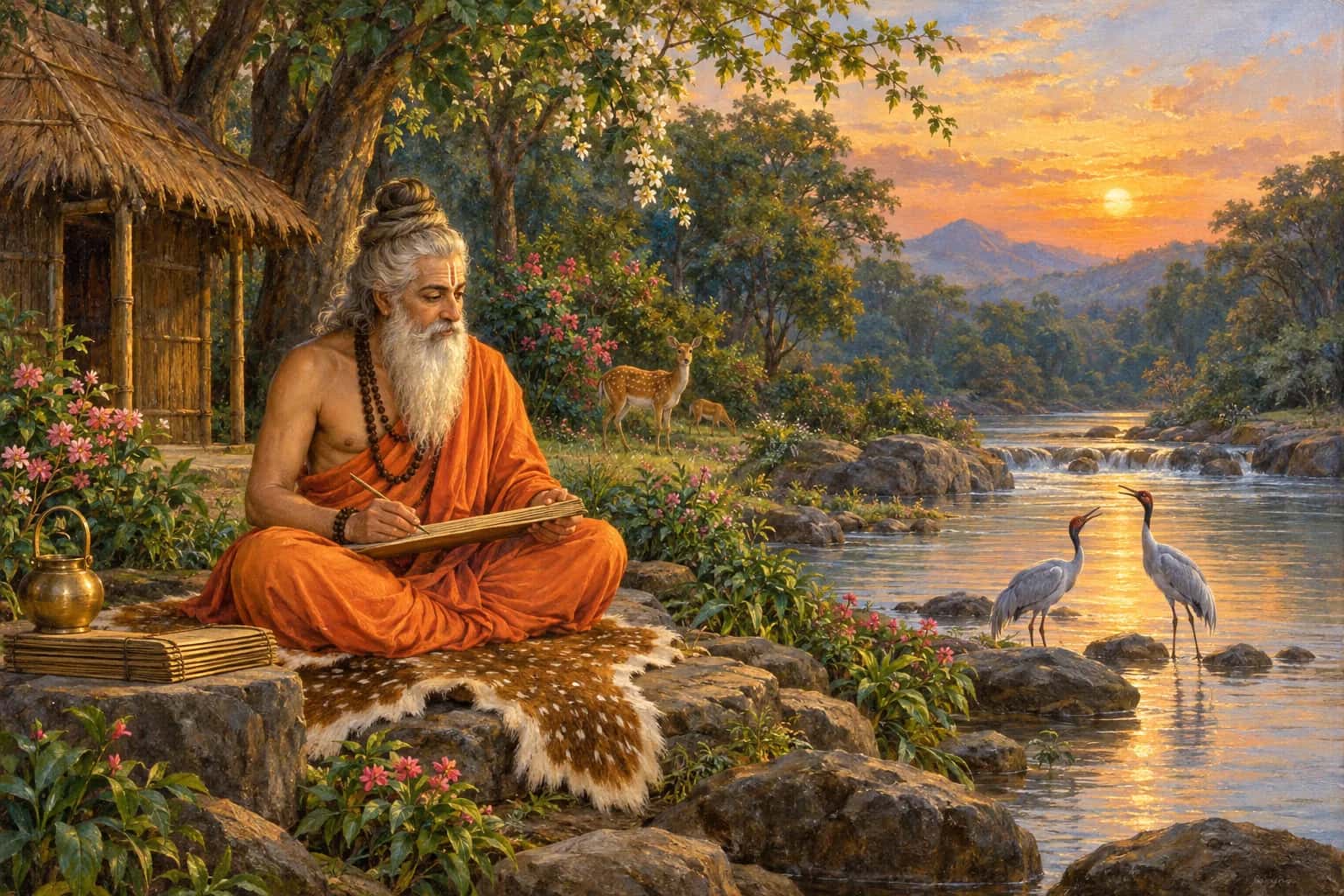
Maharshi Valmiki composed the Sanskrit Ramayana. Goswami Tulsidas composed the Ramcharitmanas, the Ramayana read and recited in most Hindi-speaking homes. Many poets have told Shri Ram's story in their own languages. Other names readers encounter include Kamban's Tamil Ramavataram, Krittibas's Bengali Ramayana and the Adhyatma Ramayana. Thus, the answer depends on which text we mean.
Maharshi Valmiki and the first shloka
The story of Maharshi Valmiki's first shloka begins with grief. On the bank of the Tamasa river, a hunter kills one of a pair of krauncha birds. Seeing the suffering caused by this act, Maharshi Valmiki utters words that take the form of a verse.
Tradition remembers this as the first shloka, a metrical verse. Maharshi Valmiki is therefore called the Adi Kavi, the first poet, and his Ramayana the Adi Kavya, the first poem. The account directs our attention to compassion. The poet sees another creature's suffering, and that suffering finds expression in poetry.
The Sanskrit Ramayana traditionally contains about 24,000 shlokas in seven kandas. It tells of Shri Ram, Mata Sita, exile, separation, the search for Mata Sita, the war in Lanka and the return to Ayodhya.
Devotees place the events in the Treta Yuga. Scholars generally place the core composition in the first millennium BCE, most often between the seventh and fourth centuries BCE. These dates concern the composition of the text. They answer a different question from when devotees understand the events to have occurred.
How Lava and Kusha carried the poem forward
A poem must be heard if its teaching is to reach others. Lava and Kusha, the sons of Shri Ram and Mata Sita, learn the Ramayana from Maharshi Valmiki and sing it. The poet teaches, and his students carry the account into the world through their voices.
This is how tradition describes the poem's transmission. Before us stands a teacher with two young singers. Their learning becomes something they can share. Similarly, when we read the Ramayana aloud at home, our reading gives others an opportunity to listen.
Goswami Tulsidas in Ayodhya in 1574
Goswami Tulsidas brings Shri Ram's story into Awadhi, a language of the people of the Ram Janmabhoomi region. In the Bal Kand, he records that he begins the Ramcharitmanas in Ayodhya on Ram Navami, a Tuesday, in Vikram Samvat 1631, corresponding to 1574 CE.
The title Ramcharitmanas means “the Manas lake of Shri Ram's deeds”. Its seven kands carry the story from the invocations and birth of Shri Ram through His coronation and the teachings on devotion in Uttar Kand.
Goswami Tulsidas writes mainly in chaupais and dohas, alongside sorathas and chhands. These forms give the account a rhythm suited to reading and recitation. The teaching can be heard, remembered and returned to.
Why many families call the Ramcharitmanas “Ramayan”
In a north Indian home, “Ramayan” usually means the Ramcharitmanas. It is the text most Hindi-speaking families read and recite. Hence, someone who says that Goswami Tulsidas wrote the Ramayan may be referring quite precisely to the book used in that home.
For example, a child hears the family preparing to read the Ramayan and brings the familiar volume from the shelf. Years later, the child encounters the Sanskrit Ramayana and sees Maharshi Valmiki named as its author. Both names belong, but to different works. Similarly, we understand the authorship clearly when we identify the text being discussed.
The Hanuman Chalisa, another gift of Goswami Tulsidas
Goswami Tulsidas also composed the Hanuman Chalisa, forty verses in praise of Hanumanji and the most recited Hindi prayer. Many people know this prayer before they begin reading the Ramcharitmanas. The author is the same, while each work offers its own form of devotional reading.
Begin with a few verses and give them attention. To keep reading on the phone, the free Ramayan app includes both the Ramcharitmanas and the Valmiki Ramayana, with offline reading and bookmarks.
Questions people ask
Did Valmiki or Tulsidas write the Ramayana?
Maharshi Valmiki composed the Sanskrit Ramayana. Goswami Tulsidas composed the Ramcharitmanas in Awadhi in the sixteenth century. Both tell Shri Ram's story. In everyday north Indian speech, the Ramcharitmanas is often called the Ramayan, which is why readers encounter both authors' names.
Who wrote the Ramayana first?
Maharshi Valmiki is traditionally regarded as the first poet, the Adi Kavi, and his Sanskrit Ramayana as the Adi Kavya. His work precedes Goswami Tulsidas's Ramcharitmanas. Scholars place the Sanskrit epic's core composition in the first millennium BCE, while Goswami Tulsidas began his work in 1574 CE.
Was the Ramayana originally written in Hindi?
Maharshi Valmiki's Ramayana is in Sanskrit. The Ramcharitmanas, familiar in most Hindi-speaking homes, is in Awadhi. Goswami Tulsidas composed it in a language of the people of the Ram Janmabhoomi region. Calling it the Hindi-region Ramayana helps distinguish its place in family reading from the Sanskrit epic.
Did Tulsidas also write the Hanuman Chalisa?
Yes. Goswami Tulsidas composed both the Ramcharitmanas and the Hanuman Chalisa. The Hanuman Chalisa contains forty verses in praise of Hanumanji. His other works include Vinay Patrika, a collection of devotional hymns to Shri Ram, and Gitavali, which tells Shri Ram's story through songs.