Maharshi Valmiki: the first poet and the first Ramayana
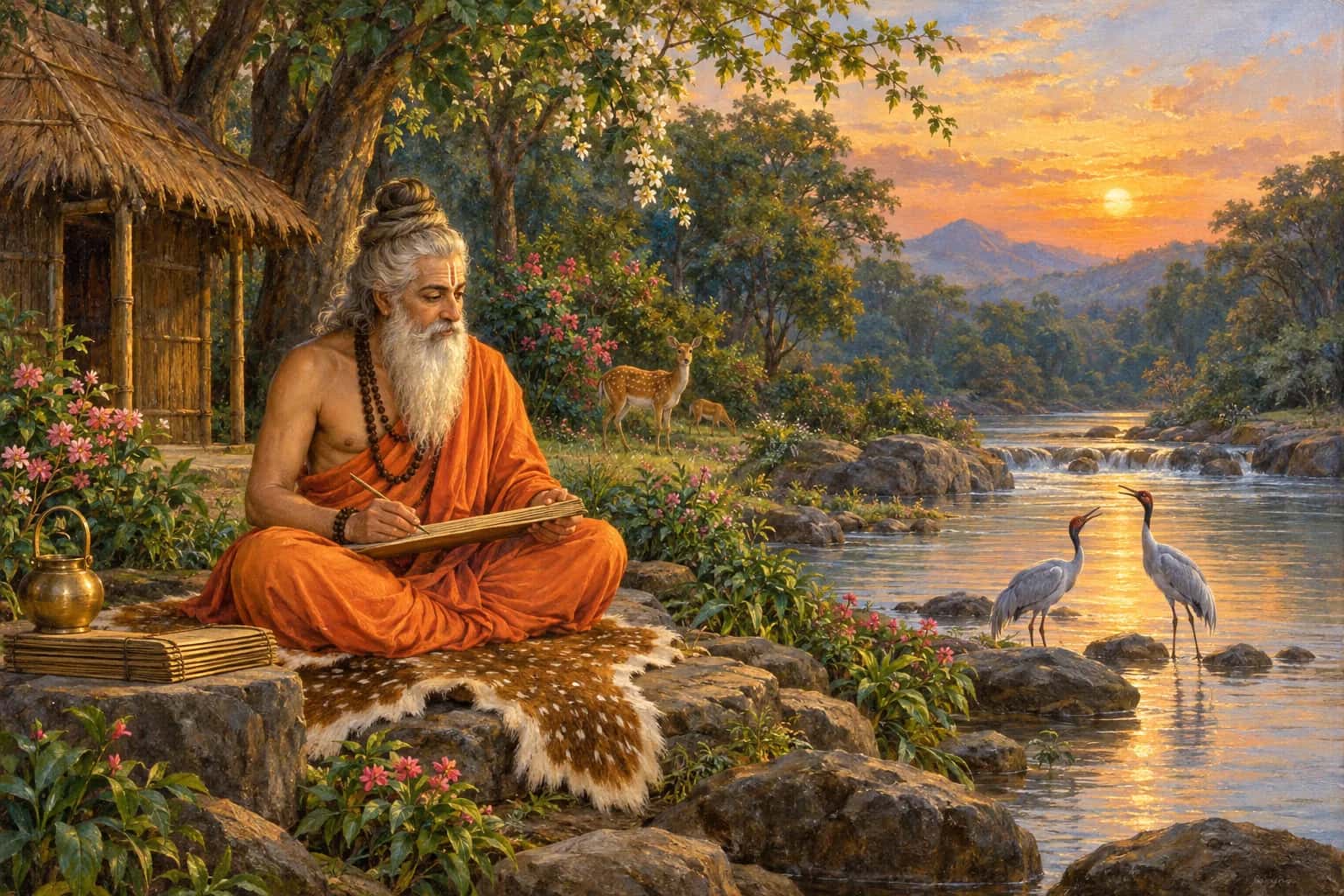
Maharshi Valmiki is revered as the Adi Kavi, the first poet, and his Sanskrit Ramayana is called the Adi Kavya, the first poem. He tells the story of Shri Ram in roughly 24,000 shlokas across seven kandas. Tradition also places him within that story, giving Mata Sita refuge and teaching her sons, Lava and Kusha, to sing the poem.
The krauncha birds and the first shloka
Compassion stands at the beginning of Maharshi Valmiki's poetry. Tradition tells that, on the bank of the Tamasa river, he sees a hunter kill one of a pair of krauncha birds. The suffering before him moves him to utter the first shloka.
The word shloka means a verse. Here, grief takes the form of poetry. The account teaches us something about the poet before we begin reading his work: he responds to another being's pain.
We may understand this through an ordinary experience. A person can pass the same tree each morning without paying attention to it. One day, a fallen nest makes that person stop and look closely. Compassion changes what the eyes notice. Similarly, the account of the krauncha birds asks us to approach the Ramayana with an attentive heart.
How the Valmiki Ramayana is arranged
The poem follows the life of Shri Ram through seven kandas, or major divisions: Bala, Ayodhya, Aranya, Kishkindha, Sundara, Yuddha and Uttara. Yuddha Kanda is also called Lanka Kanda.
Each kanda is divided into sargas, or chapters. This gives the reader a practical way to approach a scripture of roughly 24,000 shlokas. We can read one sarga, attend to its events and meaning, and then continue.
Chapter totals differ across editions. Tradition speaks of about 500 sargas, and the Gita Press edition on this site has 648. The complete reader on Ramayana.com contains 648 sargas across all seven kandas, using the Gita Press editions.
The distinction matters when comparing books or looking for a passage. A difference in chapter totals need not mean that a reader has missed an entire part of the story.
Maharshi Valmiki within his own poem
Tradition remembers Maharshi Valmiki as both the poet who tells the story and a sage who takes part in it. His ashram becomes Mata Sita's refuge. There, the account of Shri Ram's family meets the life of the sage who preserves it.
Lava and Kusha, the sons of Shri Ram and Mata Sita, learn the poem from Maharshi Valmiki and sing it. Thus, the Ramayana presents its own telling as something received from a teacher and carried forward through recitation.
This invites a particular kind of attention from us. A scripture can be read quickly for its events, yet its teaching requires us to pause. As we follow what happens, we should also consider the choices made and the duties those choices reveal.
How the Ramcharitmanas honours him
Maharshi Valmiki's Sanskrit poem and Goswami Tulsidas's Awadhi Ramcharitmanas belong to the shared telling of Shri Ram's story. The Ramcharitmanas carries that story into the language of the people of the Ram Janmabhoomi region.
Its seven kands follow the same names as Maharshi Valmiki's seven divisions, except that the sixth is called Lanka Kand. Goswami Tulsidas gives the telling his own poetic forms, chiefly chaupais and dohas.
We honour Maharshi Valmiki's place by recognising each work clearly. The Valmiki Ramayana is the Sanskrit epic of the Adi Kavi. The Ramcharitmanas is Goswami Tulsidas's devotional retelling in Awadhi. Reading both allows us to attend to each poet's telling with respect.
Where to read the Valmiki Ramayana
Begin with the complete Valmiki Ramayana, available in Sanskrit with Hindi meaning or English meaning. For guidance before opening the text, see Read the Valmiki Ramayana online.
To keep reading on your phone, the free Ramayan app includes both the Valmiki Ramayana and the Ramcharitmanas, with offline reading and bookmarks. Choose a language you understand, begin with Bala Kanda, and give the first sarga your attention.
Questions people ask
Who wrote the first Ramayana?
Maharshi Valmiki composed the Sanskrit Valmiki Ramayana and is revered as the Adi Kavi, the first poet. His work is called the Adi Kavya, the first poem. Goswami Tulsidas later retold Shri Ram's story in Awadhi as the Ramcharitmanas, which many Hindi-speaking families read and recite.
Why is Valmiki called the first poet?
Tradition connects this title with his response to a hunter killing one of two krauncha birds beside the Tamasa river. Moved by grief, Maharshi Valmiki utters the first shloka. He is therefore revered as the Adi Kavi, and his Ramayana as the Adi Kavya.
Did Mata Sita stay in Valmiki's ashram?
Yes. In the traditional account, Maharshi Valmiki's ashram gives Mata Sita refuge. Her sons, Lava and Kusha, learn the Ramayana from the sage and sing it. This places Maharshi Valmiki within the story he tells, as a teacher connected with Shri Ram's family.
How many chapters are in the Valmiki Ramayana?
The number depends on the edition. The Valmiki Ramayana has seven kandas and traditionally about 24,000 shlokas, with about 500 sargas by tradition. Ramayana.com's complete reader contains 648 sargas across all seven kandas, following the Gita Press editions available on the site.