Goswami Tulsidas: his life, his works and the Ramcharitmanas
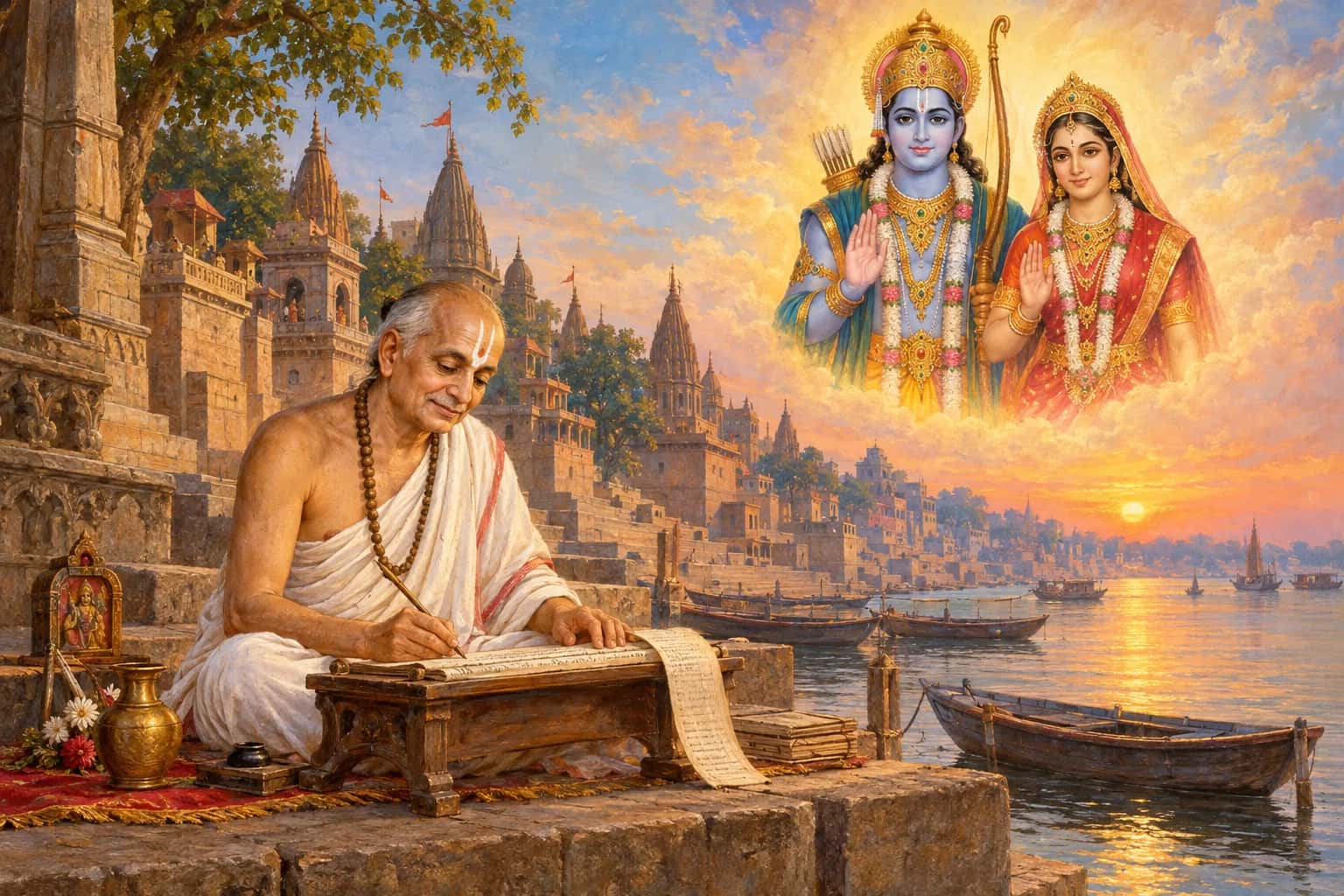
Goswami Tulsidas was the devotee and poet who composed the Ramcharitmanas, the Awadhi retelling of Shri Ram's story read and recited in many Hindi-speaking homes. He lived roughly from 1532 to 1623 CE. Through the Ramcharitmanas, the Hanuman Chalisa and his other works, he placed devotion to Shri Ram in the language of ordinary people.
His life in brief
Most accounts place Goswami Tulsidas's birth in the Rajapur region. His birth year is commonly given as 1532, though some traditions give 1511. He spent his later life in Varanasi and left his body at Assi Ghat in 1623.
These few details give us the outline of his life. His works bring us closer to his purpose. Again and again, he turns our attention towards Shri Ram, devotion, dharma and the company of Saints. We approach him most fruitfully by reading what he has given us.
The night the Manas began
Goswami Tulsidas records the beginning of the Ramcharitmanas in its Bal Kand. He began in Ayodhya on Ram Navami, a Tuesday, in Vikram Samvat 1631, corresponding to 1574 CE. His own account gives us the sacred occasion and the place.
The title Ramcharitmanas means “the Manas lake of Shri Ram's deeds.” Its language is Awadhi, a language of the people of the Ram Janmabhoomi region. Its seven kands carry the reader through Shri Ram's story, with the sixth named Lanka Kand.
The telling has several voices. Shiva speaks to Parvati, Kakbhushundi to Garuda, Yajnavalkya to Bharadwaj, and Goswami Tulsidas to his readers. Thus, we receive the story through conversations in which listening itself becomes part of devotion.
His other works
Goswami Tulsidas gives devotion several forms: prayer, song, counsel and the telling of sacred events. Alongside the Ramcharitmanas, his works include:
- Hanuman Chalisa: Forty verses in praise of Hanumanji, the most recited Hindi prayer.
- Vinay Patrika: A “petition” of hymns addressed to Shri Ram, written in Braj Bhasha.
- Kavitavali: Shri Ram's story expressed in kavitta and savaiya metres.
- Dohavali: A collection of dohas teaching dharma and devotion.
- Gitavali: Shri Ram's story told through songs in Braj Bhasha.
- Janaki Mangal: A work celebrating the wedding of Mata Sita and Shri Ram.
- Parvati Mangal: A work celebrating the wedding of Parvati and Shiva.
- Barvai Ramayan: A short telling of the Ramayana in the barvai metre.
- Ramlala Nahachhu: A folk-style song about the nail-paring ceremony of the child Shri Ram.
- Vairagya Sandipani: Verses on dispassion and the nature of a Saint.
- Krishna Gitavali: Songs of Shri Krishna.
These works offer different ways to begin reading him. A reader may turn to a prayer, a song or a teaching on devotion, then give that work steady attention.
Tulsidas and Hanumanji
Goswami Tulsidas is regarded as a devotee to whom Hanumanji granted the darshan of Shri Ram. This tradition places Hanumanji close to the heart of his devotional life. The Hanuman Chalisa gives readers a prayer through which to praise Hanumanji themselves.
The Ramcharitmanas also gives sustained attention to Hanumanji's service. In Sunderkand, he crosses the sea, finds Mata Sita, gives her Shri Ram's ring and returns with her message. His strength serves a clear purpose: the work of Shri Ram.
Why his Ramayana is sung in homes
The Ramcharitmanas is written mainly in chaupais and dohas, alongside sorathas and chhands. Its verse forms give the telling a rhythm suited to recitation. Awadhi brings that telling into the language of the people.
For example, a family may return to the same passage on successive evenings. Familiar words become easier to recite together, while their meaning still calls for attention. Similarly, reading Goswami Tulsidas asks us to bring understanding to what the tongue has learned.
The Ramcharitmanas is the Ramayana most Hindi-speaking families read and recite. In everyday speech in north India, “Ramayan” usually means this work. Sunderkand is especially often recited on its own, customarily on Tuesdays and Saturdays and in times of difficulty.
How to read him today
Begin with the Ramcharitmanas, reading the original Awadhi alongside the Hindi commentary or English translation. Read a manageable passage, attend to its meaning, and then continue. The Gita Press edition also provides nine-day and thirty-day recitation plans.
For a shorter daily reading, turn to the Hanuman Chalisa. To keep reading on your phone, the free Ramayan app offers offline reading, bookmarks and reading plans without advertisements.
Questions people ask
When and where was Tulsidas born?
Goswami Tulsidas was born in the Rajapur region by most accounts. His life is usually dated roughly from 1532 to 1623 CE, although some traditions give 1511 as his birth year. He spent his later life in Varanasi and left his body at Assi Ghat.
When did Tulsidas write the Ramcharitmanas?
Goswami Tulsidas records that he began the Ramcharitmanas in Ayodhya on Ram Navami, a Tuesday, in Vikram Samvat 1631, corresponding to 1574 CE. This records the beginning of the work. He composed it in Awadhi, a language of the people of the Ram Janmabhoomi region.
Did Tulsidas write the Hanuman Chalisa?
Yes. Goswami Tulsidas composed the Hanuman Chalisa, forty verses in praise of Hanumanji. It is the most recited Hindi prayer. It belongs alongside his larger works, including the Ramcharitmanas, and offers a short reading for those who wish to begin with praise of Hanumanji.
Are the Ramayana and Ramcharitmanas the same?
The Valmiki Ramayana is Maharshi Valmiki's Sanskrit epic. The Ramcharitmanas is Goswami Tulsidas's Awadhi retelling of Shri Ram's story, composed in the sixteenth century. In north India, people commonly use “Ramayan” to mean the Ramcharitmanas, so the word's meaning depends on which text the speaker has in mind.