Ayodhya: Shri Ram's Birthplace in the Ramayana
Ayodhya is the birthplace of Shri Ram and the city ruled by His father, King Dashrath. It stands on the Sarayu river in Uttar Pradesh. In Goswami Tulsidas's Ramcharitmanas, Ayodhya's people love Shri Ram dearer than life. Their joy at His presence, sorrow during His exile and devotion reveal what it means to place the Lord at the centre of life.
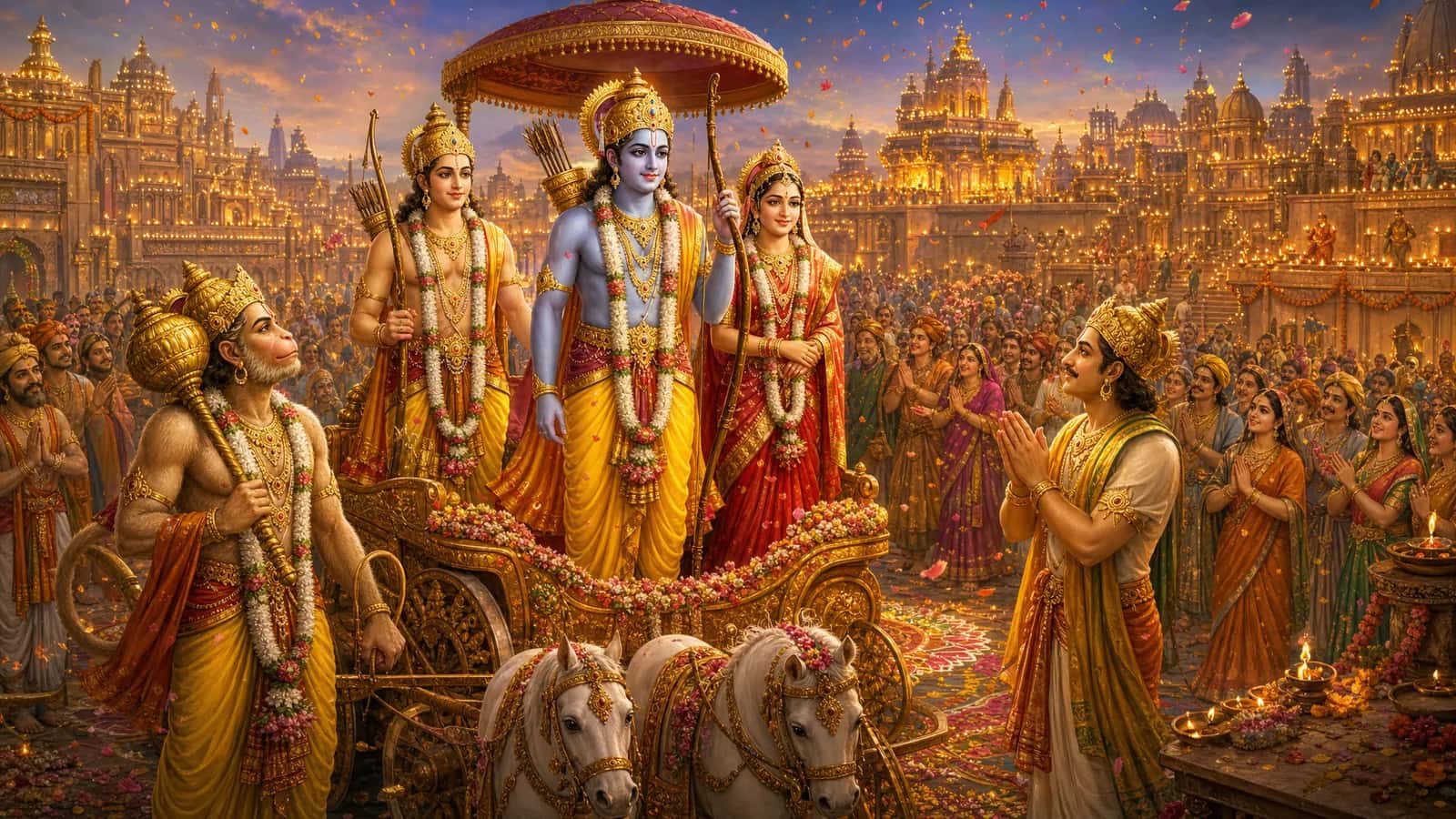
Ayodhya's love for Shri Ram
Ayodhya's happiness rests in its love for Shri Ram. In Bal Kand, Doha 204, Goswami Tulsidas describes men and women, children and elders holding Him dearer than their own lives. This affection belongs to the whole city. Shri Ram is the son of King Dashrath, and every household cherishes Him.
After the wedding at Janakpur, the marriage party reaches Ayodhya in Bal Kand, Doha 343. By Bal Kand, Doha 359, the city is filled with ever-growing delight. These celebrations show how love makes another's happiness our own. Goswami Tulsidas also begins his telling in Ayodhya on Ram Navami, as he records in Bal Kand, Doha 34. The city is both the home of Shri Ram and a place where His story is lovingly told.
When Shri Ram leaves Ayodhya
The prospect of Shri Ram's coronation fills Ayodhya with joy, but Kaikeyi's demands interrupt the preparations in Ayodhya Kand, Doha 28. The exile tests a city whose happiness depends upon His presence.
Before leaving, Shri Ram asks Lakshman to remain and care for their parents and the people in Ayodhya Kand, Doha 71. His concern teaches that duty includes the suffering of those who depend upon us. Even as He prepares to depart, He thinks of their welfare.
In Ayodhya Kand, Doha 81, the citizens lament as Shri Ram leaves. Their love is answered by His own. In Ayodhya Kand, Doha 141, His eyes fill with tears when He remembers Ayodhya, His parents and His brothers. Devotion does not make the heart unfeeling.
Bharat's service and Shri Ram's return
Bharat refuses the throne and meets Shri Ram at Chitrakoot. In Ayodhya Kand, Doha 323, he installs the Lord's wooden sandals upon Ayodhya's throne after receiving his preceptor's advice and blessing. These paduka, or wooden sandals, express whom Bharat recognises as the rightful ruler. His devotion takes the form of service rather than possession.
Shri Ram's own reverence for Ayodhya appears as He returns after the war. In Lanka Kand, Doha 120, Shri Ram and Mata Sita bow to the city. His eyes fill with tears and He rejoices. The Lord whom Ayodhya loves bows before His home. Read these passages together, then consider Bharat's example: fulfil the responsibility entrusted to us without treating it as something we own.
Verses
कोसलपुर बासी नर नारि बृद्ध अरु बाल। प्रानहु ते प्रिय लागत सब कहुँ राम कृपाल॥२०४॥
The people of Ayodhyā, men and women, elderly people as well as children, all held the gracious Śrī Rāma dearer than life. (204)
Bal Kand, Doha 204एहि बिधि राम सबहि समुझावा। गुर पद पदुम हरषि सिरु नावा॥ गनपति गौरि गिरीसु मनाई। चले असीस पाइ रघुराई॥१॥
In this way Śrī Rāma consoled all and cheerfully bowed His head at the lotus feet of His preceptor. Invoking Lord Gaṇeśa, Goddess Pārvatī and the Lord of Kailāsa, Śiva, and receiving the blessings of His Guru, Śrī Rāma proceeded further. (1)
Ayodhya Kand, Doha 81सुनि सिख पाइ असीस बड़ि गनक बोलि दिनु साधि। सिंघासन प्रभु पादुका बैठारे निरुपाधि॥३२३॥
Hearing this advice and receiving the great blessing (from his preceptor), Bharata called astrologers and, fixing an auspicious day and time, happily installed on the throne of Ayodhyā the wooden sandals of the Lord. (323)
Ayodhya Kand, Doha 323सीता सहित अवध कहुँ कीन्ह कृपाल प्रनाम। सजल नयन तन पुलकित पुनि पुनि हरषित राम॥१२०(क)॥
The gracious Śrī Rāma and Sītā both made obeisance to Ayodhyā. Tears rushed to His eyes, every hair on His body stood erect and the Lord felt delighted again and again. (120 A) The Lord then landed at the Triveṇī and with much joy bathed in the confluence. He, together with the monkeys, bestowed a variety of gifts on the Brāhmaṇas. (120 B)
Lanka Kand, Doha 120b Ramayan appFree. No ads. Works offline.Install
Questions people ask
Where is Ayodhya, and why is it sacred?
Ayodhya stands on the Sarayu river in Uttar Pradesh. It is sacred as the birthplace and home of Shri Ram. In the Ramcharitmanas, its people's devotion gives the city its character. Bal Kand, Doha 204 describes people of every age loving Shri Ram dearer than life.
What happens to Ayodhya when Shri Ram goes into exile?
Ayodhya is plunged into grief when Shri Ram leaves for the forest. Ayodhya Kand, Doha 81 describes the citizens' lamentation and King Dashrath's anguish. Shri Ram also remembers His home with deep affection. In Ayodhya Kand, Doha 141, His eyes fill with tears as He recalls His parents, family and Bharat.
Why does Bharat put Shri Ram's sandals on the throne?
Bharat refuses to accept the throne as his own. The wooden sandals, called paduka, express his recognition of Shri Ram's authority. In Ayodhya Kand, Doha 323, Bharat installs them on Ayodhya's throne after receiving his preceptor's advice and blessing. His act teaches us to carry responsibility in a spirit of service.