Chitrakoot in the Ramayana: Shri Ram and Bharat
Chitrakoot is a sacred place on the Mandakini river, along the Uttar Pradesh and Madhya Pradesh border, where Shri Ram stays with Mata Sita and Lakshman during exile. In the Ramcharitmanas, Goswami Tulsidas presents Chitrakoot through Maharshi Valmiki's praise, Bharat's overflowing love and the land bearing Shri Ram's footprints. Its holiness teaches us to approach the Lord with a guileless heart.
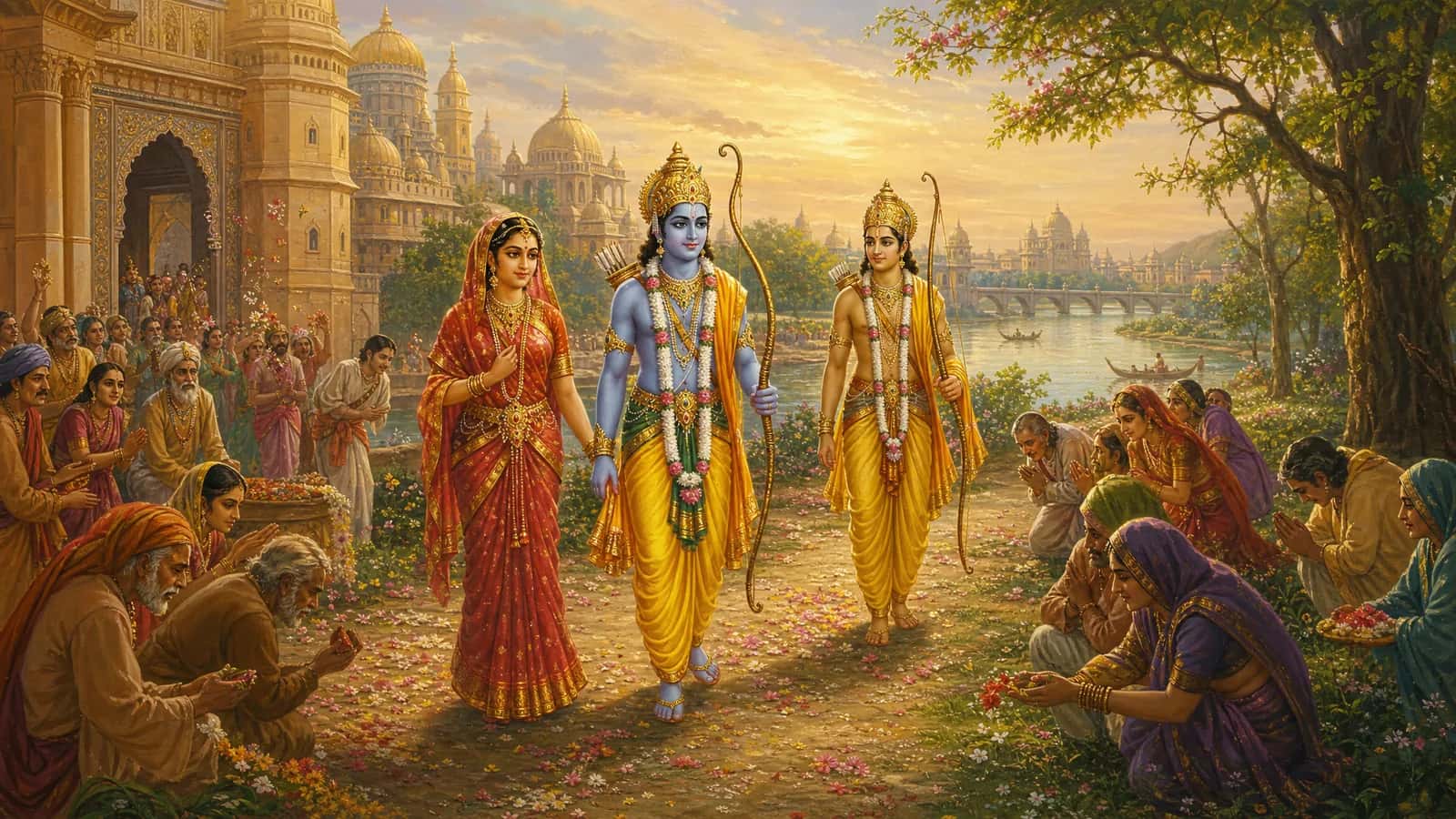
Shri Ram arrives at Chitrakoot
In Ayodhya Kand, doha 132, Maharshi Valmiki describes the glory of Chitrakoot before Shri Ram, Mata Sita and Lakshman proceed there and bathe in the sacred Mandakini. Their arrival places the river and forest within the account of Shri Ram's exile. The place becomes dear to the devotee because He dwells there.
Devotion makes us attentive to His surroundings. In Ayodhya Kand, doha 138, the gods praise even Chitrakoot's birds, deer, creepers, trees and herbage as blessed. Goswami Tulsidas directs our attention to these ordinary forms of life. Since they share the place of the Lord's dwelling, they too become objects of reverence.
Bharat sees the hill of Shri Ram
In Ayodhya Kand, doha 236, the sight of Chitrakoot fills Bharat's heart with love. Goswami Tulsidas compares his joy to that of an ascetic whose vow has reached fulfilment. Bharat sees the hill as Shri Ram's own place. His response teaches us how love changes what we see.
The devotee seeks what is connected with the Lord. In the passage at Ayodhya Kand, doha 308, Bharat asks permission to see Chitrakoot's sacred places, woods, waters and hills. Above all, he wishes to see the ground bearing Shri Ram's footprints. Shri Ram grants permission and directs him to follow sage Atri's guidance. Bharat's eagerness remains joined to obedience.
Chitrakoot and the guileless heart
Goswami Tulsidas gives Chitrakoot an inward meaning in Bal Kand, doha 31. He likens Shri Ram's story to the Mandakini, a guileless heart to Chitrakoot, and pure love to the woodland where Mata Sita and Shri Ram dwell. The teaching asks us to consider the condition of our own heart as we read about this sacred place.
Make the heart fit for His presence. A guileless heart has no need to display devotion for another person's approval. Bharat's love in Ayodhya Kand, doha 236, helps us understand this simplicity. As we read, let us attend to Shri Ram with sincerity and seek to bring that same sincerity into our conduct.
Verses
चित्रकूट महिमा अमित कही महामुनि गाइ। आइ नहाए सरित बर सिय समेत दोउ भाइ॥१३२॥
The great sage Vālmīki then described at length the infinite glory of Citrakūṭa and the two brothers proceeded with Sītā and bathed in the sacred stream, Mandākinī. (132)
Ayodhya Kand, Doha 132राम सैल सोभा निरखि भरत हृदयँ अति पेमु। तापस तप फलु पाइ जिमि सुखी सिरानें नेमु॥२३६॥
Beholding the beauty of Śrī Rāma’s hill (Citrakūṭa) Bharata’s heart overflowed with love even as an ascetic, who has reaped the fruit of his penance (तप), rejoices on the fulfilment of his vow. (236) [PAUSE 20 FOR A THIRTY-DAY RECITATION] [PAUSE 5 FOR A NINE-DAY RECITATION]
Ayodhya Kand, Doha 236एकु मनोरथु बड़ मन माहीं। सभयँ सकोच जात कहि नाहीं॥ कहहु तात प्रभु आयसु पाई। बोले बानि सनेह सुहाई॥१॥
“I have one great longing at heart; but due to fear and diffidence I am unable to express it.” “Tell me, dear brother, what it is.” Thus receiving the Lord’s permission Bharata replied in words sweetened by love: (1)
Ayodhya Kand, Doha 308रामकथा मंदाकिनी चित्रकूट चित चारु। तुलसी सुभग सनेह बन सिय रघुबीर बिहारु॥३१॥
The story of Śrī Rāma is the river Mandākinī (which washes the foot of Citrakūṭa); a guileless heart is Mount Citrakūṭa (one of the happy resorts of Śrī Rāma during his wanderings in the forest); while pure love, says Tulasīdāsa, is the woodland in which Sītā and Śrī Rāma carry on Their divine pastimes. (31)
Bal Kand, Doha 31 Ramayan appFree. No ads. Works offline.Install
Questions people ask
Where is Chitrakoot?
Chitrakoot lies on the Uttar Pradesh and Madhya Pradesh border, on the Mandakini river. In Ayodhya Kand, doha 132, Maharshi Valmiki praises its glory before Shri Ram, Mata Sita and Lakshman proceed there and bathe in the sacred stream. The Ramcharitmanas presents it as a place made dear by Shri Ram's presence.
Why does Bharat go to Chitrakoot?
Bharat goes to Chitrakoot to meet Shri Ram during His exile. In Ayodhya Kand, doha 236, the sight of Shri Ram's hill fills him with love. In the passage at doha 308, he also asks permission to visit the sacred surroundings, especially the land bearing Shri Ram's footprints.
What does Chitrakoot teach us in the Ramcharitmanas?
Chitrakoot teaches us to prepare a sincere heart for devotion. In Bal Kand, doha 31, Goswami Tulsidas compares a guileless heart to Chitrakoot and pure love to the woodland where Mata Sita and Shri Ram dwell. Begin with this practice: read His story attentively and examine the sincerity of your own intentions.