Urmila in the Ramcharitmanas: Wedding at Janakpur
Urmila is one of the three princesses whom King Janaka summons in bridal attire during the wedding celebrations in the Ramcharitmanas. Goswami Tulsidas names her alongside Mandavi and Shrutakirti in Bal Kand, Doha 325. Her appearance follows the marriage of Shri Ram and Mata Sita, as the wedding narrative turns to the other princesses.
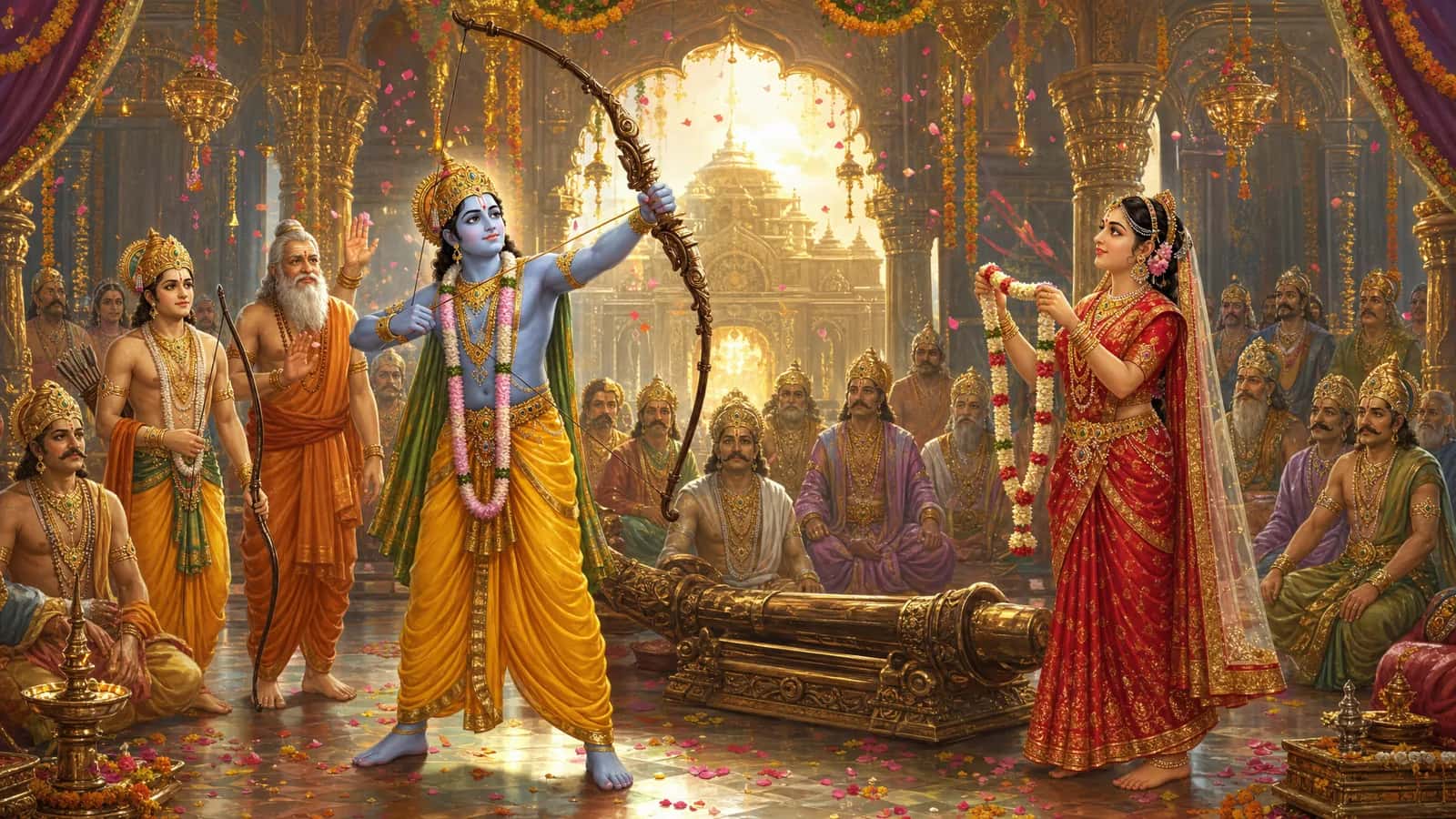
Urmila enters the wedding narrative
The marriage of Shri Ram and Mata Sita has filled the assembly with joy. In Bal Kand, Doha 325, Goswami Tulsidas first shows them seated together on an exalted seat. King Dashrath rejoices at the sight, and the celebration extends throughout the universe. Against this background, Urmila enters the narrative.
At Sage Vashishtha's direction, King Janaka sends for Mandavi, Shrutakirti and Urmila, each dressed as a bride. The account thus moves from the marriage of Shri Ram and Mata Sita to the other princesses. Urmila's name belongs within this shared celebration at Janakpur.
What the passage tells us about Urmila
Goswami Tulsidas introduces Urmila by name and by her place among the princesses called to the wedding assembly. In Bal Kand, Doha 325, she appears with Mandavi and Shrutakirti. All three arrive in bridal attire at King Janaka's summons, following the direction of Sage Vashishtha.
We should attend carefully to whom each description belongs. The passage identifies Mandavi as the eldest daughter of Kushaketu, King Janaka's younger brother, and praises her qualities. Those particular details describe Mandavi. For Urmila, the account here gives a brief appearance within the wedding proceedings, without a separate description of her character.
Reading Urmila's appearance with care
A brief mention calls for attentive reading. In Bal Kand, Doha 325, Urmila has no recorded speech in the passage presented here. Goswami Tulsidas names her as the wedding proceedings continue, while the surrounding description dwells on the joy of Shri Ram and Mata Sita's marriage.
This gives us a clear place to begin understanding her appearance: the assembly, the summons and the bridal attire. It does not give an account of her later life or her experience during the exile. Read her introduction within the wedding narrative, allowing the details actually given to guide our understanding of the scene.
Verses
बैठे बरासन रामु जानकि मुदित मन दसरथु भए। तनु पुलक पुनि पुनि देखि अपनें सुकृत सुरतरु फल नए॥ भरि भुवन रहा उछाहु राम बिबाहु भा सबहीं कहा। केहि भाँति बरनि सिरात रसना एक यहु मंगलु महा॥ १ ॥
Śrī Rāma and Princess Jānakī sat together on an exalted seat (Āsana) and King Daśaratha was glad at heart to see them. Joy thrilled along his veins again and again as he perceived the wish-yielding tree of his meritorious deeds bear new fruit. There was rejoicing all over the universe; everyone proclaimed that Śrī Rāma’s wedding had been accomplished. With one tongue how could anyone describe in full the magnificent and auspicious event, the joy of which knew no bounds? (1)
Bal Kand, Doha 325 Ramayan appFree. No ads. Works offline.Install
Questions people ask
Where is Urmila mentioned in the Ramcharitmanas?
Urmila is named in Bal Kand, Doha 325, during the wedding celebrations at Janakpur. After describing Shri Ram and Mata Sita seated together, Goswami Tulsidas relates how King Janaka summons three other princesses at Sage Vashishtha's direction. They are Mandavi, Shrutakirti and Urmila, each dressed in bridal attire.
Who appears with Urmila at the wedding?
Mandavi and Shrutakirti are named alongside Urmila in Bal Kand, Doha 325. King Janaka sends for all three princesses after receiving Sage Vashishtha's direction. Their appearance follows the description of Shri Ram and Mata Sita together on an exalted seat, with King Dashrath rejoicing in their marriage.
Does this passage describe Urmila's life during the exile?
The passage in Bal Kand, Doha 325, concerns the wedding celebrations and Urmila's appearance in bridal attire. It gives no account of her life during the exile. The fourteen years of exile for Shri Ram, Mata Sita and Lakshman belong to the later narrative in Ayodhya Kand.